Mercedes-Benz GLC 400 EV Review: Is This the Best Three-Pointed EV Yet?
Mercedes’ global best-seller has gone all-electric, and it’s arriving on our shores soon. Should you wait? We spent a day driving the new GLC 400 around Stuttgart to find out.



AMGs may get the most hits on Instagram, and the S-Class may be the favourite among celebrities and the who’s who of the world, but mainstream Mercedes-Benz models still keep the brand's cash registers ringing louder than anything else. And currently sitting at the top of the perch as the best-selling Merc in the world is the GLC -- yes, it’s way ahead of the C-Class and E-Class.
Also Read: Mercedes-Benz GLE L Revealed in China with 120mm Longer Wheel Base
Mercedes calls the GLC its ‘all-rounder’ SUV, so it was only natural to bring out an electric version. Dubbed the GLC 400, the BEV version of Mercedes’ best-selling vehicle has already hit the roads in global markets, and it’s now heading to India very soon. Bookings start in the first week of October, and deliveries will commence in December. More importantly, unlike the CLA EV, which arrived as a CBU-only model, this new-age Merc EV will be assembled in India right from the start. Mercedes India MD & CEO Santosh Iyer claimed this is the first time a model will be assembled in India within less than a year of its global launch. That underlines just how important the model could be for the company's electric-vehicle strategy in the country.

Since the model coming to India will be of the same specification (except for RHD for our market) as the one sold in Germany/Europe -- the GLC 400, that is -- Mercedes decided to fly a bunch of us to its hometown of Stuttgart to get an early taster of the GLC EV. Now, while the drive was relatively short, it was enough to get a first impression of what this new electric SUV will bring to the table.
Mercedes GLC 400 Design: Contemporary, not Conservative
At first glance, the GLC 400 electric looks like an evolution of the existing GLC. However, that’s where the similarities end because the GLC 400 is based on a completely new MB.EA architecture. What’s more, unlike the CLA EV’s platform, the GLC’s architecture is not engineered to accommodate an internal-combustion engine. However, Mercedes is expected to introduce a facelifted version of the regular GLC in the near future, and some of the design cues seen here could influence that model as well.

Thanks to the new EV-only architecture, the GLC 400 electric has grown larger in all areas, along with an 84mm increase in its wheelbase. To give you an idea, it’s now longer than the previous-gen GLE.
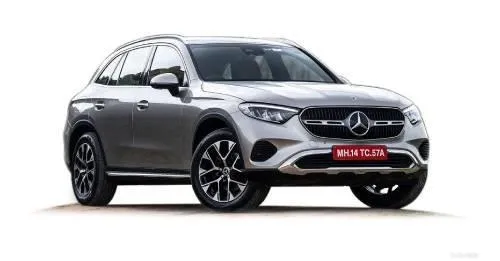
As for the exterior styling, Mercedes hasn't gone down the radical-design route with the GLC 400. Instead, the company has retained the familiar proportions and visual identity of the GLC while adding several distinctive EV-specific details. The front features Mercedes' illuminated grille treatment, featuring as many as 900 light bulbs and 140+ LEDs, to give it the signature star-studded bling. The AMG Line version on test here gets a darker finish on the grille, which I prefer over the lighter and brighter grille on lower trims.

The headlights retain the familiar Mercedes-Benz design language, while the side profile is recognisably GLC. However, the extra length, coupled with a swooping rear end, gives it a more stretched, fastback-esque appearance. Around the back, it gets a new set of connected tail-lamps with neatly integrated LED patterns that give the GLC 400 a distinctive identity. The rear three-quarter view is arguably the most attractive angle of the car.

Overall, the design is unlikely to polarise buyers. It isn't excessively futuristic, but it doesn't look boring either. It hits the aesthetic sweet spot, which will appeal to a wide range of customers.
Mercedes GLC 400 Interior & Features: IMAX on Wheels
Step inside, and you’ll find yourself in an IMAX theatre, or so it feels, thanks to the GLC’s dashboard, which is dominated by a large, panoramic Hyperscreen display setup that stretches across the cabin. The main central screen is joined by a digital driver's display and a dedicated passenger display, and all of these combined take up about 39.1 inches of space! My TV at home is smaller than that, no kidding!

There is a lot of information to take in, but the system is relatively intuitive to operate. The interface also incorporates AI-based computing and advanced processing hardware, meaning you don’t necessarily have to interact with the system using physical controls. A simple voice command will sort out most of the stuff. The passenger display is particularly interesting. It doesn’t get a privacy screen, but if the driver gets distracted by it, the cabin camera monitors the driver's eyes and pauses or turns the screen off.
The head-up display is brilliant since it integrates seamlessly with the Maps navigation in the car. It shows the directions clearly, with visual animations, which makes it really helpful when driving through busy streets. That said, it isn’t perfect, as we noticed some lag in the navigation -- the position on the map would sometimes be around 100 metres behind where we actually were.

The quality of the cabin is typical Mercedes. Materials feel premium, the finishing is impressive, and there’s hardly anything to complain about. The front seats provide a cocooning feel while offering plenty of adjustment. What’s more, Mercedes has now replaced some of the haptic controls on the steering wheel with physical roller controls. That is a welcome change, although there are still more touch-sensitive controls than we would ideally like. Another interesting feature is the panoramic glass roof, which uses multiple elements to provide different levels of transparency. It can be adjusted between different settings, allowing occupants to control how much light enters the cabin. A 15-speaker 4D Burmester sound system was standard fit in our test car, and suffice it to say, it produced magnificent audio.

The GLC 400 electric is primarily designed as a luxury SUV, and comfort is one of its strongest attributes. The front seats are excellent, while the spacious cabin provides plenty of room for occupants. The rear seat has ample legroom, although the upright seating position means taller passengers may not be able to stretch out quite as much as they might expect from a vehicle of this size. The flat floor created by the EV architecture helps with practicality, although the floor height can slightly affect the under-thigh support. If you want to be primarily chauffeured around, you might want to double-check the space at the back. Having said that, Mercedes maintains that the GLC is primarily an owner-driven vehicle, which explains why the company has focused more heavily on the driving experience than on creating a limousine-like rear compartment.
Mercedes GLC 400 Performance, Range, Ride & Handling: Subdued Brilliance
The GLC 400 electric is offered with a dual-motor, all-wheel-drive setup. Total system output stands at 476bhp, and in typical EV fashion, it produces 800Nm of twisting force, which allows the SUV to dart from 0-100km/h in just 4.3 seconds -- that’s sports-car-rivalling performance, especially considering that the GLC tips the scales at 2.6 tonnes!

However, the most impressive thing isn't simply how fast it is. It is the manner in which the power is delivered. The GLC 400 electric doesn't feel explosive or intimidating. Instead, the acceleration is remarkably measured and progressive. You can access its performance without the car constantly feeling like it is trying to overwhelm you. It makes covering ground quickly a comfortable and composed affair.
The GLC 400 electric uses a battery with a usable capacity of 94kWh and has a claimed WLTP range of up to 715km. In real-world conditions, a range of around 550-600km should be achievable even in Indian driving conditions. The GLC 400 also uses a two-speed transmission, with the second (taller) ratio engaging at higher speeds to improve efficiency.

Charging is another major strength. The GLC 400 electric incorporates an 800-volt electrical architecture and supports charging at up to around 330kW -- Mercedes claims that it can add 300km of range in 10 minutes with that. However, chargers capable of delivering 150kW and above are still relatively uncommon in India, meaning owners will not always be able to exploit the vehicle's maximum charging capability.
I only got to drive for around 100km. And since most of the driving was done on Germany’s immaculate autobahns, my seat time turned out to be about an hour or thereabouts behind the wheel of the GLC 400. However, a couple of things stood out for sure. First up, the GLC 400 electric feels more like a proper luxury SUV. The NVH levels are exemplary even at triple-digit speeds; the ride quality -- thanks to S-Class-derived air suspension -- is simply stellar, and the performance is more than adequate for all occasions.

The most impressive aspect has to be the ride quality because this is one area where the GLC has completely transformed. Unlike some electric SUVs that have a firm underlying ride because of their heavy batteries, the GLC 400 manages to remain supple without feeling floaty. On German highways, it glided over imperfections with impressive composure. Now, of course, the roads in Germany weren’t half as bad as what we have here in India, but based on the adjustability on offer with the air suspension, it should also perform well on our less-than-perfect roads. The GLC’s ride comfort could become one of its biggest selling points.
What’s more, despite its considerable weight, body control is reasonably good. It isn’t the sharpest Merc out there, but there’s no sense of waywardness or unpredictability even when you up the pace. The steering, however, is a bit of a let-down. It feels dead at centre -- something that couldn’t be fixed even by selecting different drive modes. The steering just doesn't provide as much feedback as we would expect from a vehicle with this level of performance. And this lack of connection was particularly noticeable during our drive, which mainly consisted of high-speed driving on arrow-straight autobahns. You could say that Mercedes prioritised refinement and ease of use over anything else, but then, for an SUV that Mercedes believes is going to be driven mostly by the owner, it should give the driver some sense of involvement.
Mercedes GLC 400 Verdict
The GLC 400 is already doing great numbers for Mercedes in global markets, so it won’t have difficulties finding takers in India as well.

Pricing will be crucial, though, and while Mercedes hasn’t announced it yet, it should be in the region of ₹80-85 lakh (ex-showroom), considering it will be assembled locally. At that price, the GLC 400 will make for a compelling case for luxury car buyers who want to go green but don’t want to compromise on the usual Mercedes-Benz attributes of comfort, space and opulence. Plus, the fact that it has no direct rival in India (the BMW iX3 is still some months away), will only play in its favour.