
Tesla Model Y vs Mercedes-Benz CLA: The Battle for the Future of Cars
Can German engineering match Silicon Valley innovation? We compare Mercedes-Benz and Tesla to see who is shaping the future of cars.



At the turn of the 21st century, an upstart from Silicon Valley by the name of Tesla arrived out of the blue with an ambitious plan – to make electric cars mainstream and, more importantly, desirable. Against all odds, Tesla did exactly that. In little more than a decade, the American brand didn’t just succeed; it tore up and rewrote the rulebook by transforming EVs into cutting-edge aspirational products. Tesla’s first-mover advantage, combined with its tech-led innovations, propelled it to the top of the EV food chain in a remarkably short span, while forcing the entire industry to play catch-up.
Also Read: Mercedes-Benz CLA EV First Drive Impressions - Bringing the A-Game
Legacy carmakers spent years studying Tesla’s playbook, and it seems they’re finally beginning to close the gap. No car demonstrates that better than the all-new Mercedes-Benz CLA EV. When I attended its press launch in India earlier this year, Mercedes couldn’t stop talking about its supercomputing capabilities, AI integration and giant displays. It was the first time I’d heard Mercedes spend more time discussing processors and software than horsepower, handling or its, erm, legacy.
When I drove the CLA EV the very next day, I came away genuinely impressed. In terms of EV technology, it’s truly a tour de force. It’s the best EV Mercedes has built so far, period. But is it Tesla good?
To find out, we brought together the all-new CLA EV and the Tesla Model Y, which happens to be the brand’s biggest success story and also the best-selling electric vehicle of all time.
Tesla Model Y vs Mercedes-Benz CLA: Journey to the Top
Rome wasn’t built in a day, and neither was Tesla. Today, it is widely regarded as the benchmark for EV technology, but this stardom didn’t come overnight. Tesla was founded in 2003, but it wasn’t until 2008, when it launched the Roadster, that it truly became a car manufacturer. Tesla adopted a top-down strategy for its electric car journey, which is why it began with a desirable sports car. At the time, the Roadster was the first production electric sports car capable of travelling more than 350km on a single charge, and it was also the first production EV to use thousands of commodity lithium-ion cells, a blueprint that has since become the industry standard.

The Roadster wasn’t exactly a sales success, but then again, it wasn’t meant to be. It was a halo model designed to prove what electric cars could achieve. You could say the real journey for Tesla began in 2012 with the launch of the Model S – a premium four-door sedan that introduced a raft of new technology and was developed almost entirely from the ground up. It popularised over-the-air software updates in the automotive industry, offered excellent driving dynamics and a stellar range, while Tesla also began rolling out its Supercharger network around the same time. It solved one of the biggest problems associated with EVs – range anxiety – by creating the world’s first large-scale fast-charging network.
Tesla’s rise to the top of the EV food chain, though, was driven by its seamless integration of hardware and software over the years. The company follows a vertically integrated business model, meaning it controls much of its supply chain by manufacturing many of its critical components in-house, including battery packs, electric motors, power electronics and software. Over the years, Tesla also introduced Autopilot, its world-famous semi-autonomous driving system. In 2016, it expanded beyond cars by acquiring SolarCity, a solar energy company. Around the same time, the company changed its name from Tesla Motors to Tesla, Inc., signalling that it was a technology company and not just a carmaker.

Tesla’s first stab at the mass market came in 2017 in the shape of the Model 3. It quickly went on to become the world’s best-selling electric car, followed by the Model Y in 2020, which is essentially a Model 3 in a compact SUV body. The Model Y took Tesla’s success story to another level, becoming the world’s best-selling passenger car, electric or otherwise, for multiple years. Quite an achievement for a brand that’s just over two decades old.

With the Model Y being Tesla’s bread and butter, it made perfect sense for the company to enter the Indian market with its best-seller. This is our first taste of a Tesla, and while the initial pricing was a bit of a downer, as a product – or more importantly, as a car – the Model Y is mighty impressive, and then some.
The Model Y’s technology-first philosophy is evident before you even step inside. Instead of a conventional key, you get a simple NFC key card that unlocks the car with a tap on the B-pillar. While futuristic, it can be a little inconsistent, often requiring multiple attempts to locate the sensor. The number of scratches on the B-pillar of our test car was proof we weren’t the only ones struggling with it.
Once inside, the 16-inch central touchscreen dominates the cabin. With a crisp display, an Apple-like interface and excellent responsiveness, it serves as the control centre for virtually every function in the car. Everything from opening the boot, frunk and charging flap to adjusting the mirrors, seats and drive modes is handled through this single screen. What’s more, there isn’t a conventional gear selector – even that is operated via the touchscreen.

That said, the software experience is among the best in the business. Tesla has also turned charging stops into entertainment breaks by offering apps like Netflix and YouTube, alongside games such as Beach Buggy Racing, Cuphead and Stardew Valley. Some even let you use the steering wheel and pedals as controllers, making for a genuinely unique experience. The downside is that, with everything routed through the touchscreen, an inadvertent tap can interrupt what you’re doing. Tesla’s touchscreen-first philosophy carries over to the rear as well. There are no physical climate controls, with all the air-conditioning functions integrated into the 8-inch rear touchscreen.
While the interface is intuitive, there’s no denying that Tesla’s pursuit of minimalism has gone a little too far. Even so, the Model Y’s cabin remains an impressive showcase of technology. Lastly, while the Model Y gets a comprehensive suite of ADAS features, Tesla’s world-famous Autopilot remains unavailable in India due to regulatory and traffic-related challenges.

Practicality remains another strong point. The rear bench is wide enough to accommodate three adults, and complementing the spacious cabin is a massive boot, making the Model Y one of the most practical EVs in its segment.
The Rocky Road
Compared to Tesla, Mercedes’ road to electrification has been full of hiccups and hurdles. Despite its engineering expertise, decades of experience and seemingly limitless resources, Mercedes’ EV story has largely been one of missed opportunities. Changing priorities and repeatedly shifting its EV strategy meant the brand’s electric ambitions took off far more slowly than expected.

In the early years, Mercedes simply lacked conviction. Rather than laying the foundations for a dedicated EV strategy and sticking to it, the company treated electric cars as side projects instead of the future of the business. Like many legacy automakers, Mercedes underestimated just how quickly the industry would change, while Tesla seized the opportunity with both hands.
Mercedes’ first serious modern attempt at an EV came in 2019 with the EQC, the debut model of its new ‘EQ’ electric sub-brand. It was a refined and comfortable luxury SUV, but hardly revolutionary. Built on an adapted combustion-engine platform, it carried all the compromises that came with such an approach. Having driven the EQC extensively, I can tell you that it always felt like a half-baked product, especially by Mercedes standards.
Even so, Mercedes rapidly expanded its EV portfolio over the next few years with models like the EQA, EQB, EQE, and EQS. They were excellent luxury cars in their own right, but none truly redefined the segment. The sales figures reflected that. While the EQ models found buyers, they never enjoyed the same level of success or admiration as Mercedes’ traditional combustion-powered lineup, and they struggled to match Tesla’s dominance in the premium EV space.
By 2024, Mercedes acknowledged that a reset was needed. The company announced it would retire the standalone ‘EQ’ branding for future electric cars and instead integrate EVs into its core model lineup. The transition began with the G 580 with EQ Technology and now continues with the all-new CLA with EQ Technology – the car you see here.
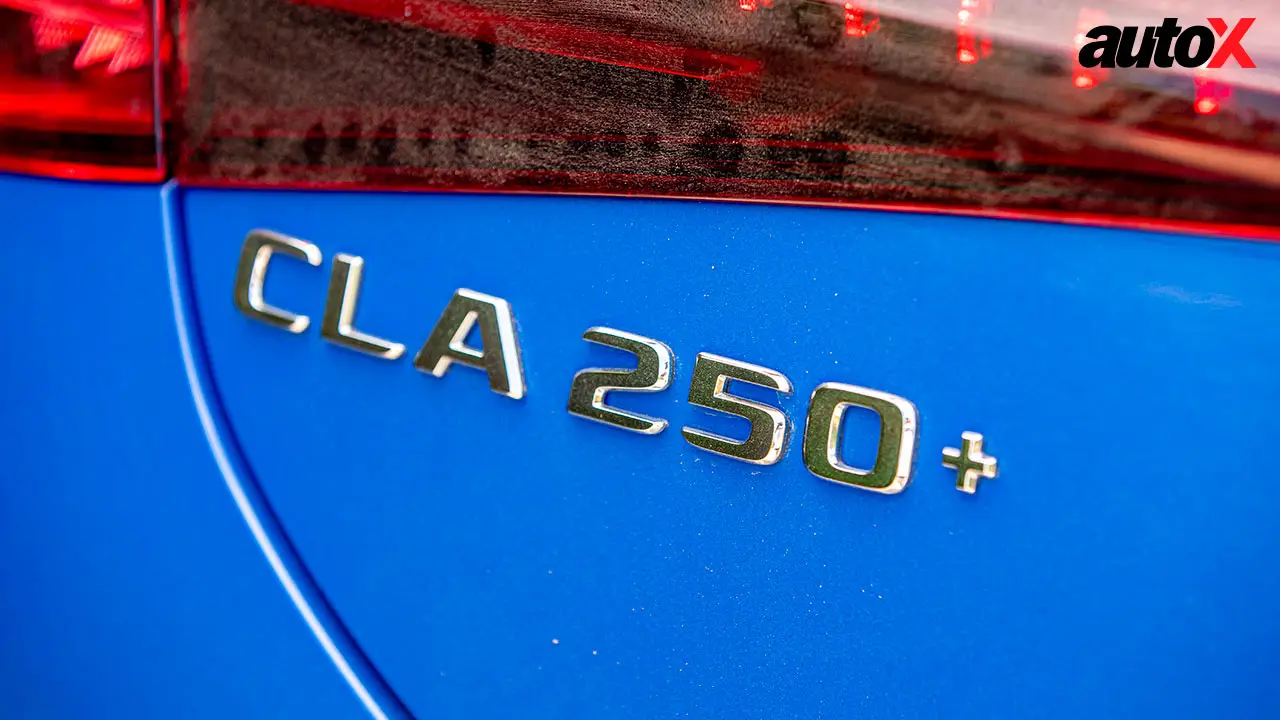
The CLA is different than any Merc EV that has come before it. Why? Well, that’s because for the first time Mercedes has reimagined an EV around software and computing, rather than simply swapping an engine for a battery. Sure, it’s built on the all-new MMA platform, which can also accommodate hybrid powertrains, but this architecture was developed with electrification as the priority.

Then there’s the 800-volt electrical architecture – double the voltage of the Model Y’s 400V system – which supports ultra-fast charging at up to 320kW. Admittedly, those figures don’t mean much in India just yet, thanks to the country’s nascent charging infrastructure. But when it comes to absolute bragging rights, Mercedes has edged ahead of Tesla.
Mercedes also claims the CLA EV has the computing power of four supercomputers, all running its new MB.OS operating system. This enables deep integration between the vehicle’s systems, over-the-air software updates and AI-powered assistance through Google Gemini and ChatGPT. Sounds familiar? It should, because this philosophy closely mirrors Tesla’s approach.

On the inside, however, Mercedes has taken the opposite approach to Tesla’s minimalism. The CLA features a fully digital cockpit with a large central touchscreen, a digital driver’s display and plenty of illuminated stars and ambient lighting. Unlike the Tesla, it also gets wireless Apple CarPlay and Android Auto, while maintaining Mercedes’ trademark build quality. The best part, though, is that the CLA EV doesn’t feel like a conventional Mercedes that has simply been electrified. It feels like a fully realised modern electric car that just happens to wear a three-pointed star. And then you come to the driving experience…
Tesla Model Y vs Mercedes-Benz CLA: Driving Powerhouse(s)
On paper, the CLA’s numbers are impressive. It packs an 85.5kWh battery, a claimed range of nearly 790km (MIDC) and produces 268bhp, with a claimed 0-100km/h time of 6.7 seconds. Despite carrying a heavy battery pack and weighing well over two tonnes, the CLA masks its mass remarkably well. It handles confidently, refinement levels are exemplary, and there’s a measured, effortless way in which it gathers speed. It’s a similar story when it comes to comfort. Despite its low stance, the CLA absorbs imperfections exceptionally well, gliding over broken roads with remarkable composure. Sure, being an EV, there’s still that signature underlying firmness, but the suspension is beautifully judged.
Visually, too, Mercedes has taken a very different approach from Tesla. The CLA is bold, with illuminated elements and a heavy dose of chrome that’s clearly aimed at younger buyers. By comparison, the Model Y looks decidedly plain.

Switching to the Model Y reveals a completely different philosophy. The first thing that strikes you is how little there is in front of the driver in the traditional sense. There’s no driver’s display, and not even a head-up display.
Shockingly (pun intended), the Model Y drives phenomenally well for a car from a tech company. The compact steering wheel feels quick and precise, while the straight-line performance is noticeably punchier than the Mercedes. Despite looking like a gadget on wheels, the Tesla has all the fundamentals sorted. The steering is direct, the brake-by-wire system feels surprisingly natural, and overall, it’s a cohesive and confidence-inspiring car to drive.
Where the Tesla loses some ground is ride quality. The China-spec version sold in India feels noticeably firmer, particularly at low speeds on our less-than-perfect roads. As speeds rise, however, the suspension settles into its stride and becomes more compliant, while the road-holding remains exceptional. It was my first time driving a Tesla, and I came away genuinely impressed.
Tesla Model Y vs Mercedes-Benz CLA: Verdict
If you want a cutting-edge gadget that’s also phenomenally enjoyable to drive, Tesla is still the benchmark. But if you’re looking for a traditional luxury car that finally delivers truly state-of-the-art EV experience, Mercedes is now making an incredibly compelling case.

The biggest takeaway, though, is that the gap between Silicon Valley and Stuttgart has narrowed dramatically. The lines between a legacy carmaker and a tech company have become increasingly blurred, and that’s perhaps the biggest victory of all for the EV industry.


