Hyundai Grand i10 Nios
The Hyundai Grand i10 Nios is a compact hatchback that offers seating for 5 people. It includes LED DRLs, an 8-inch touchscreen with smartphone connectivity, a wireless charger, and rear AC ventRead More


Hyundai Grand i10 Nios Features and Specifications
The Hyundai Grand i10 Nios is a 5-seater car with a wheelbase of 2450 and a ground clearance of 165. It comes with manual and automatic transmission options. Different variants include different transmission types and fuel compatibilities.
 Engine1197
 Torque114 Nm @ 4000 rpm
 Mileage19.5
 Power82 bhp @ 6000 rpm
 TransmissionManual
 FuelPetrol
Hyundai Grand i10 Nios Price
Hyundai Grand i10 Nios is available in 15 variants – the base model is and the top model is
The Hyundai Grand i10 Nios is a five-seater hatchback loaded with cutting-edge technology and essential safety features. Its bold and stylish exterior design compliments its slick performance on the road.
Let’s have a look at the features and specifications of this affordably priced car from Hyundai.
Grand i10 Nios Engine & Performance
Hyundai Grand i10 Nios Colour Options
Hyundai Grand i10 Nios is available in 9 different colors namely Fiery Red, Spark Green, Polar White, Aqua Teal, Typhoon Silver, Titan Grey, Spark Green with Black roof, Polar White with Black roof, Amazon Grey.
- Fiery Red
- Spark Green
- Polar White
- Aqua Teal
- Typhoon Silver
- Titan Grey
- Spark Green with Black roof
- Polar White with Black roof
- Amazon Grey
How is the Grand i10 Nios?
 Pros
Pros
-
82–83 bhp @ 6000 rpm and 114 Nm torque @ 4000 rpm with the 1.2 L petrol engine.
-
Petrol ~18–21 kmpl ARAI; CNG ~27–32 km / kg estimated (CNG available).
-
Six airbags + ABS + TPMS + cruise control across variants.
-
260 litres of cargo capacity in petrol variants.
-
8″ touchscreen (in Sportz onward), wired Android Auto & Apple CarPlay, wireless phone charging (select dual-tone), rear AC vents.
 Cons
Cons
-
~82 bhp petrol output is modest compared to some rivals with ~90 + bhp.
-
~16 kmpl for AMT petrol and ~18–21 kmpl isn’t top in segment.
-
CNG’s 60 kg tank significantly reduces usable boot space vs petrol.
-
India specs have a 2-star safety rating — lower than top competitors.
Hyundai Grand i10 Nios Expert Reviews
By Manav Sinha
22 Mar, 2023
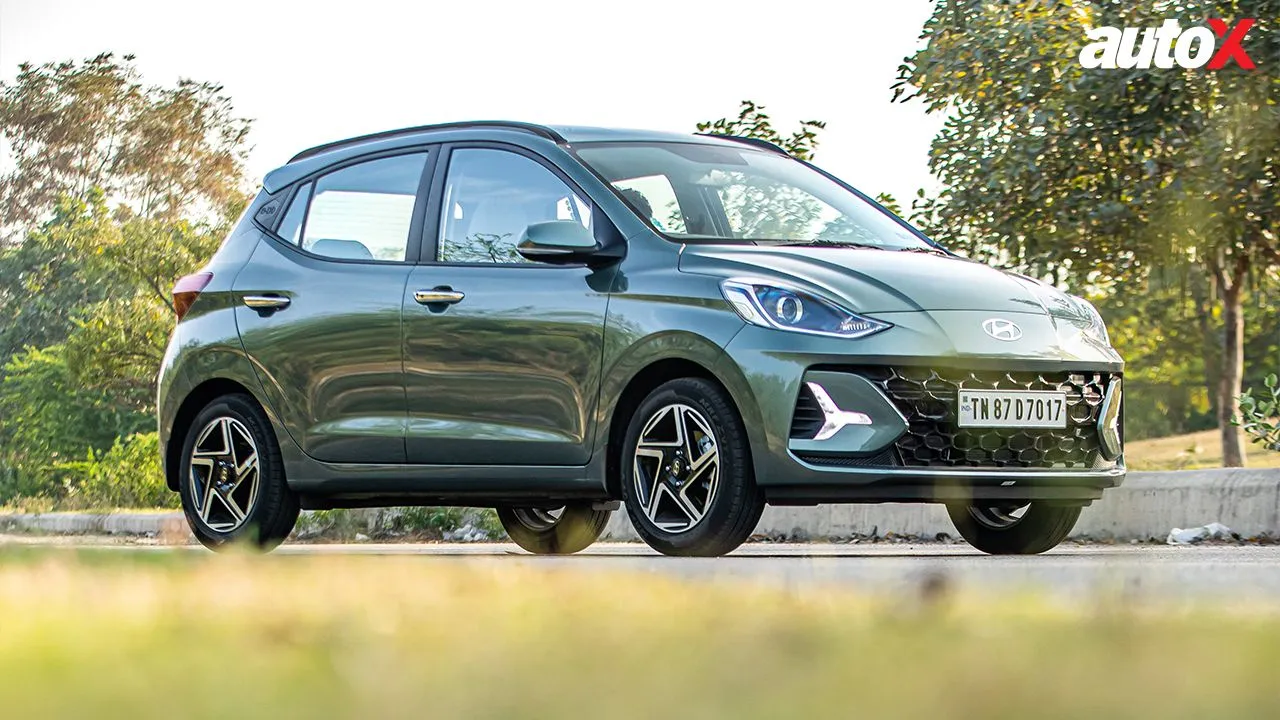
Getting a hatchback right is a difficult and challenging task for automakers, for they have to not only bring together the most they can in a small form factor but also adhere to a strict budget. The task has become even more challenging lately because of the rising popularity and affordability of compact and sub-compact SUVs. Hyundai, for instance, typically sells more units of the Venue compact SUV than the Grand i10 Nios. However, they are not giving up on the latter – in fact, they have brought in a facelift version of the Grand i10 Nios, featuring an updated design and new equipment. What’s Different? The new Hyundai Grand i10 Nios gets new LED Daytime Running Lights and an updated grille which pretty much takes up all the space there is left on the front bumper. On the sides, it sports new 15-inch alloy wheels, and at the back, it gets new LED taillamps, which are connected by what seems like a light bar, but it’s just a reflector. Overall, the design continues to look and feel premium and upmarket. However, an actual LED light bar connecting the taillamps, just like the one on the Venue, would have made the Nios’ design significantly cooler. Inside, the older semi-digital instrument cluster has been replaced by a conventional two-dial instrument cluster. The MID of the top variant will now show tyre pressures as well. The seat upholstery is now a lighter shade of grey, and footwell lighting has been introduced as well. The top variant now comes with Type C-USB charging ports and cruise control too. Design-wise, everything else remains identical. Also Read: New Hyundai Grand i10 Nios Sportz Executive Trim Introduced at Rs 7.16 Lakh A big addition has been made in the safety department, for it now comes with four airbags with ABS and EBD as standard. The top variant, on the other hand, will offer six airbags, ESC, ISOFIX seat mounts, hill-hold assist, and automatic headlamps. When you couple these with other features like wired Android Auto and Apple CarPlay support, Bluetooth, rear AC vents, auto climate control, keyless entry, push-button start, and wireless charging, you quickly see that the Grand i10 Nios is now a feature-loaded car. The touchscreen of the top-spec variant (the one we tested) deserves special mention, for it is easily the best infotainment system in the under ₹10 lakh segment in India. Mechanically, the car can only be had with the 1.2-litre engine, as the turbo option has been axed. This engine comes mated to either a 5-speed manual gearbox or an AMT transmission. But is it Really Different? Despite the changes, the reason for buying the Hyundai Grand i10 Nios remains the same – it’s a well-built hatchback that is good for daily commutes and is feature-loaded. Yes, it may not have a peppy performance, but it does offer great practicality, a thoroughly refined drivetrain, a very light steering setup that makes taking U-turns a breeze, and a suspension setup, which can tackle bad roads and potholes with ease. The biggest highlight of the Grand i10 Nios is the fact that it does not make you feel like you are missing out in any sense or that you have settled for less by buying a hatchback of this size. On the contrary, with a premium appeal and a dashing appearance, it makes you look sensible and stylish. And now that it complies with the upcoming RDE (real-world driving emission) norms and offers better safety features as standard, it justifies its price better than ever before. [tabs] [tab title="Hyundai Grand i10 Nios"] Fuel: Petrol Engine: 1,197cc 4-Cylinder Transmission: 5-Speed Manual Power: 82bhp @ 6,000rpm Torque: 114Nm @ 4,000rpm Price: ₹5.69 – 8.47 Lakh (Ex-Showroom) X-Factor: It continues to be a complete commuter car that now looks better than ever. Pros • Engine refinement • Build quality • Infotainment system Cons • Uninspiring performance [/tab] [/tabs]

By Shivank Bhatt
21 Sep, 2020
Hyundai has equipped the Grand i10 Nios with a peppy turbo petrol motor. Does the new engine make it marginally quicker or there's more zing on offer? We find out. Small turbo petrol engines – the sort of engines you see in all kinds of cars apart from, quite ironically, small hatchbacks. Come to think of it, if there’s is a kind of vehicle to which these peppy and frugal engines belong the most, it has to be the hatchback. But, because they’re expensive, and India is a price-sensitive market, carmakers don’t seem too keen on the idea of turbo engines under the hood of mass-market hatchbacks. Sure, the likes of Maruti Suzuki Baleno RS and Tata Tiago JTP spiced things up with 1.0-litre turbo motors, but both are now, sadly, out of commission. Now, while 2020 might not have gone to plan, there’s some good news – 1.0-litre turbo engines are making a comeback in small hatchbacks. It started with Volkswagen offering the 1.0-litre TSI motor with the Polo – along with a manual gearbox, nonetheless. And now, we’ve also got the Hyundai Grand i10 Nios Turbo. It's like waiting for ages for a bus to arrive, and then two come along at once! We’ve already managed to get our hands on the new Polo, and despite being a decade old car technically, it turned out to be quite a hoot. But, personally speaking, the Grand i10 Nios Turbo is what interests me a little more, as it’s a more modern and up-to-date car. But is it fun to drive? Sportz-y Base For a supposedly performance-oriented version of the regular Grand i10 Nios, the Turbo version does little to distinguish itself from its naturally aspirated sibling. Apart from ‘Turbo’ badging on the grille and boot-lid, there’s nothing different about the Nios Turbo. But since it’s based on the Sportz variant – one lower from the top-end Asta trim – it gets all the bells and whistles, such as projector lamps, diamond-cut alloy wheels, and dual-tone paint scheme. That’s all good, but I wish Hyundai had offered it with the optional N Line kit, which is available in European markets (sporty grille, larger wheels, etc.) – it’d have given the Nios Turbo some character of its own. Overall, apart from the Tiago-like rear-end, I like the Nios’ compact and inoffensive design though. But it could definitely do with a little more aggression, especially in the Turbo derivative. Inside, there’s a similar story. The cabin is unchanged from the regular version. This red-black dual-tone car gets an all-black theme along with red inserts and contrast stitching, which make it feel kind of sporty. The seats are supportive and creature comforts are the same as regular Sportz version – you get 8-inch touchscreen infotainment, wireless smartphone charging, and much more. Apart from the scratchy plastics on the doors, the quality of materials, and the fit-and-finish are top-notch. The most impressive thing about this car is its rear-seat space, which is, well, very spacious. In terms of practicality then, it’s still as good. Peppy Puppy On duty here is Hyundai group’s 1.0-litre three-cylinder turbo engine, which is also offered in the Venue, the new Verna, and the recently launched Kia Sonet. However, the engine in the Nios has been detuned, as it produces 99bhp as opposed to 118bhp in other cars. Torque, at 172Nm, is identical to the others though. The manual gearbox in the car is a five-speed unit and not a six-speeder like others. Now you may think the Grand i10 Nios Turbo is getting a stepchild like treatment here, but that’s not the case. You see, this is a much lighter car as compared to its other siblings, and as a result, it’s a really fast machine! In fact, it can clock 0 – 100km/h in under 10 seconds! The turbo motor has turned the car into an absolute hoot. First and foremost, there’s hardly any turbo lag under 1,500rpm, which means that you’ll struggle to stall it even when you’re pulling it from as low as 15km/h in 2nd gear. And once the tach needle flies past 1,800rpm, your surroundings blur quite instantly. From 2,000rpm to 6,500rpm, this motor runs riot! The torque delivery is linear, and it revs quite freely all the way to its redline, which is what I found very exciting. Not to mention, the engine sounds quite sporty and at times, you can also hear the electric wastegate making fluttering sounds during lift-offs. The most impressive thing is the engine refinement and cabin insulation though. Even when you’re revving the daylights out of this motor, you hardly hear anything inside the cabin. At idle, however, there are mild vibrations through the doors and gear lever. Coming to the gearbox, it’s smooth-shifting and has short and precise throws. The clutch action is light, making this an effortless drivetrain in the city. That said, the gearbox's taller ratios and the wider powerband of the turbo motor mean that you don’t really find yourself working the transmission that often. You also don't miss that extra cog, because even on highways, you can comfortably cruise at 120km/h with the engine spinning at 2,500rpm in 5th gear. The tall gear ratios also help in extracting decent fuel economy figures – even with a heavy right foot, I managed 13 – 15km/l in mixed driving conditions. The Grand i10 Nios has a good base setup, which we already experienced last year during our annual track day. The chassis is rigid and the suspension setup is a little firm – in fact, in the Turbo version, the spring rates have been reworked, so it’s even firmer. Overall, the handling characteristics are quite neutral. Its body roll is minimal, and when you’re cornering hard, the nose stays flat and the car stays on the intended track. The steering offers good feedback and is quite direct (surprising for a Hyundai, we know). The only killjoy is the low rolling resistance tyres. When you’re driving enthusiastically, they scream and give up quite easily. On the upside, you’ll find yourself pulling wheelspins in 2nd gear due to the tyres' poor grip levels, and maybe it's just me, but I find it to be very gratifying. Head & heart connection You know there aren’t many cars on the market that appeal to your head and heart at the same time, but the Grand i10 Nios Turbo is one of the few exceptions! The turbo motor is a hoot, the car's ride-and-handling balance is spot on, the cabin is spacious, and it’s packed with all the modern features you’d want in a hatchback these days. Sure, it costs nearly a lakh more than the regular Sportz version, but given the smile that the forced-induction motor puts on your face, I think it's justified. All Hyundai needs to do now is slap the N Line kit on the Nios Turbo and turn it into a complete hot hatch for the masses. [tabs] [tab title=" Hyundai Grand i10 Nios Turbo"] Engine: 998cc / 3-Cylinder / Turbocharged Fuel: Petrol Transmission: 5-Speed Manual / Front-Wheel Drive Power: 99bhp @ 6,000rpm Torque: 172Nm @ 1,500 - 4,000rpm Price: ₹7.75 Lakh (Ex-Showroom, New Delhi) X-factor: Appeals to the head & heart at the same time. Pretty much the perfect hot-hatch for masses. Pros • Engine performance • Practical & exciting city car Cons • Pricey • Needs better tyres [/tab] [/tabs] https://www.youtube.com/watch?v=5__PRAfX0Ic

Hyundai Grand i10 Nios Dealers in New Delhi
autoX has a list of 0 authorized Hyundai Grand i10 Nios dealers in India. They provide servicing to all the Hyundai cars including the Grand i10 Nios. Find here the contact information, full address, and Google map directions of the nearest dealer for your Grand i10 Nios around you.
Compare Hyundai Grand i10 Nios with Similar Cars

Grand i10 NiosHyundai
Ex-Showroom Price
₹ 5.47 Lakh
onwards
Engine
1197 - 1197 cc
Fuel Type
CNG / Petrol
Transmission
AMT / Manual
Mileage
27 Kmpl
Power
82 bhp @ 6000 rpm
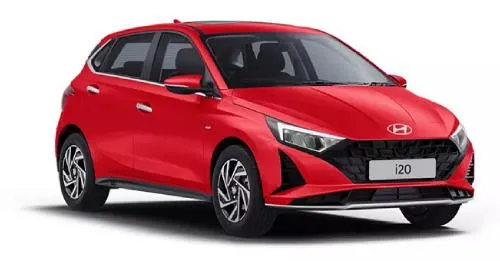
i20Hyundai
Ex-Showroom Price
₹ 6.87 Lakh
onwards
Engine
1197 - 1197 cc
Fuel Type
Petrol
Transmission
Automatic (CVT) / Manual
Mileage
18 Kmpl
Power
87 bhp @ 6000 rpm
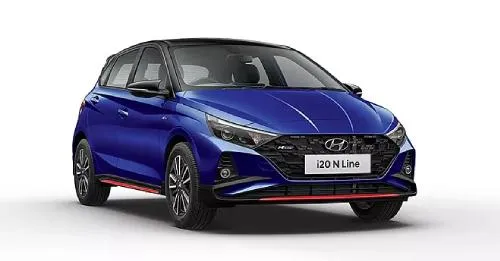
i20 N LineHyundai
Ex-Showroom Price
₹ 9.14 Lakh
onwards
Engine
998 - 998 cc
Fuel Type
Petrol
Transmission
Automatic (DCT) / Manual
Mileage
20 Kmpl
Power
118 bhp @ 6000 rpm
Hyundai Grand i10 Nios Safety Ratings

Adult
7.05 Max. 17 Adult

Child
15 Max. 49 Child

Hyundai Grand i10 Nios Images

Hyundai Grand i10 Nios Questions & Answers
Q: What is the boot space of the Hyundai Grand i10 NIOS?-
Q: Does the Hyundai Grand i10 NIOS have a CNG variant?+
Q: Is the Hyundai Grand i10 NIOS available with an AMT transmission?+
Q: Does the Hyundai Grand i10 NIOS have rear AC vents?+
Q: What safety rating does the Hyundai Grand i10 NIOS have?+
Hyundai Grand i10 Nios Price in India
| City | Ex-showroom Price |
|---|---|
| Rohtak | Rs. 5.47 Lakh onwards |
| Gurgaon | Rs. 5.47 Lakh onwards |
| Faridabad | Rs. 5.47 Lakh onwards |
| Bahadurgarh | Rs. 5.47 Lakh onwards |
| Rewari | Rs. 5.47 Lakh onwards |
| Jhajjar | Rs. 5.47 Lakh onwards |
Hyundai Grand i10 Nios Brochure
Download the brochure to view detailed specs and features