Hyundai Verna

The Hyundai Verna is a stylish sedan with a 5-star GNCAP safety rating and Level-2 ADAS features. It also includes a 10.25-inch navigation and digital cluster, heated and ventilated front seats,Read More

11.00 Lakh - 17.42 Lakh
EX 1.5 Petrol MT
New Delhi

Hyundai Verna Features and Specifications

The Hyundai Verna is a 5-seater car with a wheelbase of 2670 and a ground clearance of 165. It comes with manual and automatic transmission options. Different variants include different transmission types and fuel compatibilities.

  • Engine
    1497
  • Torque
    143.8 Nm @ 4500 rpm
  • Mileage
    18.6
  • Power
    113 bhp @ 6300 rpm
  • Transmission
    Manual
  • Fuel
    Petrol

Hyundai Verna Price

Hyundai Verna is available in 18 variants – the base model is and the top model is

Verna Engine & Performance

Hyundai Verna Colour Options

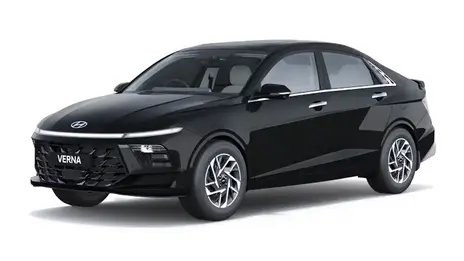
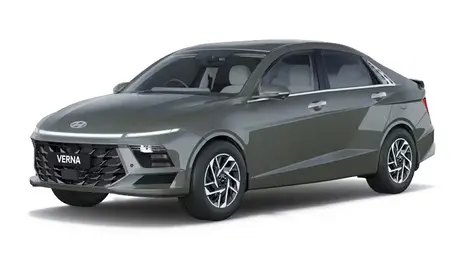
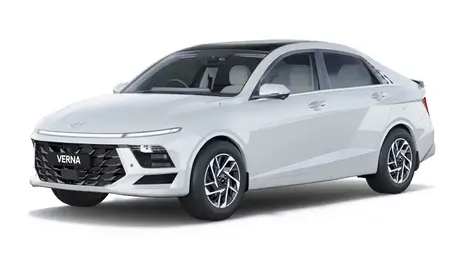
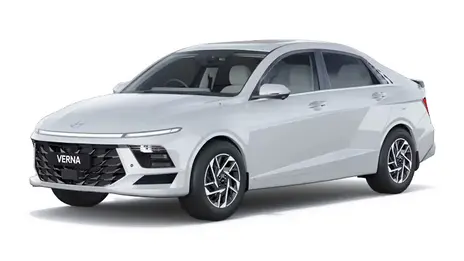
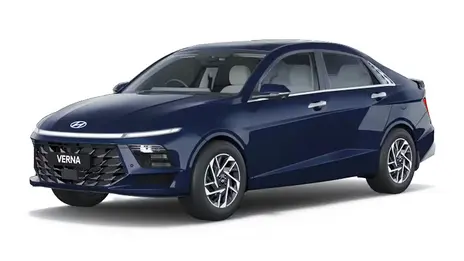
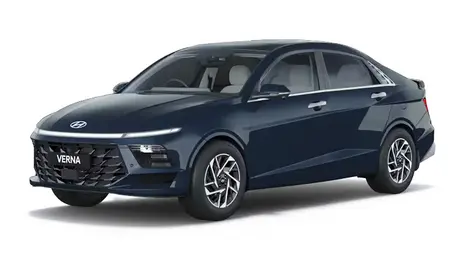
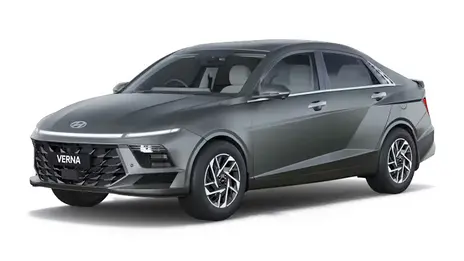
Hyundai Verna is available in 9 different colors namely Titan Grey, Abyss Black, Atlas White, Typhoon Silver, Starry Night, Fiery Red, Tellurian Brown, Atlas White with Black Roof, Fiery Red with Black Roof.

  • Titan Grey
  • Abyss Black
  • Atlas White
  • Typhoon Silver
  • Starry Night
  • Fiery Red
  • Tellurian Brown
  • Atlas White with Black Roof
  • Fiery Red with Black Roof

How is the Verna?

Pros
Bold, futuristic design with coupe-like silhouette (new-gen).
Powerful turbo-petrol engine offers sporty performance.
Loaded with premium features and ADAS tech.
Excellent ride quality and high-speed stability.
Spacious and comfortable cabin with large boot.


Cons
No diesel engine option in the new-gen model.
Rear seat backrest is slightly upright.
Low ground clearance for rough roads.
Turbo variants are priced significantly higher.
Some may find the styling too aggressive.


Hyundai Verna Expert Reviews

Hyundai Verna Review Front

By Manav Sinha

21 Apr, 2023

Talking about any sedan these days seems unfair without talking about the sedan segment entirely. And once you do, there is a pattern that emerges and defines what the segment is going through – they are all going big, be it in terms of size, features and arguably, are vying to capture the image of a sedan that belongs to a segment above. Case in point, the City is the biggest it has ever been and almost fulfils the gap that the Civic left behind. The Skoda Slavia and the Volkswagen Virtus have taken things several notches above where the Rapid and Vento used to be. And this is where the all-new Hyundai Verna comes in too. Hyundai calls all these cars mid-large sedans – except for the Maruti Suzuki Ciaz. And they are right, the segment above these cars is virtually non-existent today with the sole flag bearer being the Skoda Octavia. But the question that we will be answering today is whether all these factors make it easy for the new Verna to establish an identity of its own or is it trying to do too many things at the same time and has lost sight of the basics? https://www.youtube.com/watch?v=8AcIbCn5_iw&t=52s&pp=ygUFYXV0b3g%3D 2023 Hyundai Verna Review: Design Let’s start by taking a closer look at the design of the car. The absolute first thing you will notice is the size and presence of the car. This is because the new Verna is now 95mm longer, 36mm wider and has a 70mm longer wheelbase. To give a better idea of what these numbers mean, the Verna is now the widest car amongst its competitors and has the longest wheelbase too. And coupled with this new design, at first glance, you may even think of it as perhaps the new Elantra! Talking about the design, there is honestly a lot to unpack. The highlight, of course, is the continuous LED strip that runs across the nose of the car. Underneath this striking design element is the new, wider grille that also houses the LED headlamps and gets a dark chrome finish. On the sides, you have 16-inch alloy wheels that in my opinion play it a bit too safe in comparison to the overall edgy design of the car, and bigger 17-inch wheels with a sportier design would have been a welcome addition. They do look smart, though. The door handles and the window belt line is finished in satin chrome but what stands out is the coupe-like roofline which connects seamlessly to the boot. At the back, the bumper gets a similar design treatment to the front grille – Parametric, as Hyundai calls it – and the highlight is the connected LED tail lamps which when turned on, show an intricate design adding a premium touch to the sedan. Overall, the all-new Verna approaches design with a fresh slate and whether you love it or not, it is something that stands out. In my opinion, it looks fantastic and a lot better when you see it in flesh than in pictures. What we drove for our first drive impressions is the Turbo variant which gets blacked-out alloy wheels with red callipers and the option of dual-tone paint finishes, like the one you see here. Non-turbo variants get silver-finished alloys and single-tine colour options. 2023 Hyundai Verna Review: Interiors and Features The good bits continue once you step inside the new Verna as well. Again, being the Turbo variant, the interiors come blacked out with red accents and include metal pedals. The non-turbo variants, on the other hand, get a dual-tone cream and black interior. Overall, the design approach to the interior of the all-new Verna is minimalistic. The dashboard is angled towards the driver and the big attraction is the combination of two 10.25-inch displays positioned in a single housing, giving it a continuous look. The Verna comes with an electric sunroof that can also be operated through voice command, it gets 64-colour ambient lighting that extends the entire width of the soft-touch dash and onto the doors, and what is a conversation starter is the new two-spoke steering wheel. The instrument cluster, although digital, is not very customisable as it is only the center MID that switches between information. The whole console, however, does change colours depending on the chosen driving mode. The touchscreen infotainment system gives a top-notch experience with great touch response with easy-to-use UI and is coupled with an eight-speaker Bose sound system which makes for a great in-car audio experience. Do keep in mind, though, that at the time of our media drives the system did not support wireless Android Auto and wireless Apple CarPlay and needed the phone to be connected through a cable. Hyundai says that a future Over-The-air (OTA) update will bring this feature to the car. There is a smart use of space as Hyundai has integrated the HVAC controls and the infotainment touch controls into a single unit which alters between the two displays with the touch of a button. There are two physical knobs too which switch their functions too. The whole setup takes a bit of time to get used to but once you do, it makes a lot of sense. Hyundai has also neatly placed the seat ventilation and heating controls just beneath it. Note that while the driver seat is electrically adjustable, the height adjustment is still done manually. Other features include a wireless phone charger, keyless entry and go, and automatic headlamps. The biggest improvement, perhaps as a whole, on the new Verna comes in the form of an increase in space – especially at the back. Despite the Verna not being taller than before, it has managed to scoop out more headroom for the rear passenger thanks to the sloping roofline. The legroom is where the biggest change is felt, however, as it has gone up substantially over the outgoing model. It is now at least at par with the segment, if not the best. The rear passengers also get a manual sunblind over the rear glass panel, and it is a good feature addition. The new Verna also boasts the largest boot space – 528 litres – in the segment. 2023 Hyundai Verna Review: Safety The Verna also gets a major boost in the safety department. It now gets ABS, EBD and six airbags as standard across all variants. Additionally, it can be had with Electronic Stability Control, Hill Start Assist, front parking sensors, Tyre Pressure Monitoring System and electrochromic inside rearview mirror. The top-spec DCT-equipped variant gets disc brakes on all four wheels and an electronic parking brake. Hyundai is also giving three years of free Bluelink subscription which includes connected features like SOS calls, geo-fencing and auto crash notifications. And lastly, the top-spec SX(O) variant, except for the manual gearbox-equipped versions, also gets radar and front camera-based Advanced Driver Assistance System (ADAS) that adds features like adaptive cruise control with stop and go, lane-keep assist, blind spot assist, forward collision warning and safe exit warning. The Honda City might have offered ADAS first in the segment, but it is the Verna (the Turbo DCT variants, specifically) that gets a more competent setup with front and rear radar modules aiding the camera which should result in better functioning in low-visibility conditions. Also Read: New-gen Hyundai Verna vs Old Model: A Detailed Comparison To sum it all up, the new Verna sees a massive improvement in the space, features and safety department. The quality, fit and finish and materials used, all have improved too. Simply put, the Verna now has the best in-car experience in the segment. 2023 Hyundai Verna Review: Driving Experience The new Hyundai Verna holds a lot of promise. After all, it has the hardware to make it the king of top trumps in the segment. It comes with the choice of two engine options - first is a 1.5-litre, naturally aspirated, 4-cylinder petrol engine that makes 113bhp of power and is available with the choice of a 6-speed manual or an 8-step CVT gearbox. While this is an aptly powerful drivetrain it is the second option that puts the Verna on top of the food chain – a 1.5-litre, turbocharged, 4-cylinder petrol engine that makes 158 bhp of power available with the choice of a 6-speed manual gearbox or a 7-speed dual-clutch transmission, making it the most powerful sedan in the segment. Now, there are some interesting choices to note here. Hyundai is no longer offering a diesel engine option and there is no hybrid powertrain either. And, the turbo-petrol engine is the new 1.5-litre unit that is replacing the older 1.4-litre turbo units in the likes of the Creta. And lastly, the turbo petrol engine is coming with a proper manual gearbox and not the two-pedal iMT system – something that enthusiasts will appreciate. We drove the turbo variant with the DCT gearbox and the takeaway is that the drivetrain is smooth and refined. The performance is not a gut-wrenching one but instead, is delivered linearly. So it does not feel “quick” right away but it is no doubt a fast car. The DCT is well-tuned for both relaxed as well as spirited driving. Also Read: 2023 Hyundai Verna vs Skoda Slavia: Price, Features, Specs, and More The ride quality has matured too. What stands out is that it does not go all the way in search of performance that it compromises everyday comfort. It is a happy balance between a soft setup meant to deal with potholes and a stiff setup for corner carving. Same with the steering too which has become a bit stiffer than before. However, the feedback is not its strongest point and honestly, that is okay. In my books, this balance works best in everyday road and driving conditions as it is not always that you want to be a hoon. And yet, given the punch that it packs, it does not leave you wanting more. 2023 Hyundai Verna Review: Verdict Overall – I’ll keep it short – Hyundai has knocked it out of the park with the new Verna that strikes the perfect balance between sportiness and comfort. They have nailed the formula for making a car that excels well enough in every department that as a whole, it becomes the most convincing package for your money. [tabs] [tab title="Hyundai Verna"] Fuel: Petrol Engine: 1,482cc / In-Line 4-Cylinder / Turbocharged Transmission: 7-Speed DCT / Front-Wheel Drive Power: 158bhp @ 5,500rpm Torque: 253Nm @ 1,500-3,500rpm Price: ₹10.90 - 17.38 Lakh (Ex-Showroom) X-Factor: Perfect balance of features, comfort and performance. Pros • Stand Out Factor • Long Feature List Cons • No Diesel / Hybrid Option [/tab] [/tabs]

New 2017 Hyundai Verna1

By Ishan Raghava

26 Aug, 2017

With the new Verna, Hyundai has a product custom made to tackle its toughest competitors. We drive it to see how it fares against some heady competition. Change, or rather the quest for improvement, as we know, is an ever-evolving process. It’s perhaps even more so in the case of a global conglomerate like Hyundai, where change can be painfully slow and long drawn. However, in the recent past, we’ve seen a resurgence of the Hyundai brand, and more importantly, we’ve seen that the company’s engineers have started focusing on specific areas of their vehicles. Take for instance, the suspension setup of their cars which was a common bugbear for most customers earlier, with the boat-like ride feeling quite uncomfortable on long journeys. And as a result of the soft setup, the handling suffered too. And, of course, there was the steering, which was devoid of any feel whatsoever. But, as change goes, things are changing for the brand, and how. From the Grand i10 onwards, the suspension setup of their cars has improved by leaps and bounds, and with the new Verna, it seems the engineers have now tackled – or are close to – correcting the lifeless steering on their products. To put it in perspective, the new Verna competes in a segment which is full of very worthy competitors with the Honda City and the Maruti Ciaz doing significant sales numbers and still finding favour with buyers. So, the Verna has its task cutout. And it begins its fight with a brand-new design language which it shares with its bigger brother, the Elantra. So, you get the clean lines of the design, along with the large cascade grille at the front, which is now going to be a design highlight for the brand. The large 16-inch wheels lend the Verna good road presence and the LED tail lamps once again are standout items on the rear end of the car. And of particular interest are a couple of new shades on the Verna, with the Fiery Red and the Flame Orange hues being standouts. It’s actually good to see a manufacturer take the gamble and offer some interesting colours rather than the standard White, Silver and Beige colour palette. The interiors too are completely new and share the basic layout with other Hyundai products. So, you get the familiar layout with the center console tilted slightly towards the driver. It features a standard fit 7-inch touchscreen that works really well and is quite sensitive to inputs, as well as featuring decent resolution. Also, the typography and the whole interface is well thought out and is very easy to use. It also features Android Auto, Apple CarPlay and MirrorLink as standard, as well as navigation. With the Arkamys sound system, the audio quality on the Verna is also quite good. However, of more interest, for me at least, and it should be for most of us, are the ventilated front seats, which are a segment first. The air blowing through the seats gives driving in our hot and sultry conditions a much-needed comfort feeling. Another stand out quality of the interiors are the quality levels and the fit-and-finish. In this area, the Verna clearly trumps both the City and the Ciaz by a clear margin. However, if there is a shortcoming to the Verna, it is the space inside the car. While the front seats are nice and comfortable – albeit the passenger seat is mounted a bit high which might limit the headroom for really tall people – the rear seats will be a certain compromise for anyone above six-feet tall. It’s not that its uncomfortable for average size adults – its actually quite pleasing a place to be in – however, if you’re above six-feet, the Verna is a tight fit. And this is where the Verna lags behind its direct competition. On the powertrain side of things, the engines are revised versions of the ones available on the last-generation car, with both the petrol and diesel featuring 1.6-litre power plants. However, the Hyundai engineers have done extensive work on the low-rpm torque delivery of the engines and that is apparent when you drive the cars. In the diesel, there is virtually no turbo lag whatsoever, and from above 1200rpm the engine just revs cleanly, no matter which gear you are in. This makes urban driving a particularly easy task where you can plop the car into third gear and just pootle around town. Of course, this power delivery also means that rather than a pronounced turbo kick or a big top end, the Verna has excellent mid-range which makes driving in both urban and highway conditions a very easy task. The NVH on both the petrol and the diesel is very well controlled, so the engine noise doesn’t seep too much into the cabin, while there is little to no vibration. The Verna now features an option of two gearboxes on both engines – a six-speed manual and a six-speed automatic. Both the gearboxes are very good to use, with the manual offering crisp shifts and well thought out gear ratios. The automatic on the other hand is a huge improvement on the four-speed gearbox of the old car, and is much more pleasing to drive than the Honda City’s CVT ‘box with its rubber band effect. Given the torque and automatic gearbox combination, the Verna in its diesel guise probably would be my car of choice in this lineup. Driving the Verna in both urban and highway conditions over some twist roads as we headed to Athiraplly from Kochi meant that we also got to experience its dynamics to quite an extent. And here the Verna stands clearly well above the last-generation car. The suspension handles both broken roads and high speeds quite well and feels very well tied down. The damping is spot on, and the car is capable of handling broken roads quite well. In fact, the suspension is almost on the verge of being a bit too stiff for Indian conditions and handles the ride and handling compromise very well. And, the new steering is a revelation from Hyundai too. It now has feel and gives you a good idea of what’s happening on the road and how the car is reacting to. It’s not yet perfect and could use a bit finer tuning, but it’s a massive step up from the steering feel of Hyundai’s of old. Of course, being a Hyundai the new Verna also comes packed with new features. This includes a brand new structure. which features a lot more ultra-high strength steel and as a result, stiffness. Along with it comes two airbags and ABS as standard on all versions of the car, as well as six airbags on the higher end models. Also, standard are other segment-first features such as the hands-free boot opening which is a bit on the slower side – it takes the car three seconds to recognise you on account of the car in your pocket – but works quite well. An impressive feature for me was the new Hyundai Auto Link which debuts with the Verna. With your car connected to your cellphone via Bluetooth, the app gives you a real-time update on the condition of your car as well as your driving style. Interestingly, it even gives you real time updates on things such as the rpm the car is being driven at, the load on the engine, the fuel level and much much more. Given its potential uses in monitoring the car usage as well as ownership tasks such as booking a service appointment for you, the app is deeply impressive. Change then, obviously, has been great for the Verna. It now features excellent vehicle dynamics, hugely improved steering feel and excellent quality and equipment levels. Pair this with the ease and comfort of owning a Hyundai and the option of manual and automatic gearboxes in both diesel and petrol engines and the new Verna makes for a very enticing package. The only thorn in its side is probably the room available in the rear seat as compared to the competition. So, if that is not a problem for you, the Verna then is currently the best overall competitor in its segment with its combination of quality and equipment levels paired with excellent pricing and good driving dynamics making it a difficult car to defeat.

Hyundai Verna Dealers in New Delhi

New Delhi

autoX has a list of 0 authorized Hyundai Verna dealers in India. They provide servicing to all the Hyundai cars including the Verna. Find here the contact information, full address, and Google map directions of the nearest dealer for your Verna around you.

No dealers available

Compare Hyundai Verna with Similar Cars

Hyundai Verna

VernaHyundai

Ex-Showroom Price

11.07 Lakh
onwards

Engine

1482 - 1497 cc

Fuel Type

Petrol

Transmission

Automatic (CVT) / Automatic (DCT) / Manual

Mileage

20 Kmpl

Power

158 bhp @ 5500 rpm

Hyundai Ioniq 5

Ioniq 5Hyundai

Ex-Showroom Price

46.05 Lakh
onwards

Engine

-

Fuel Type

Electric

Transmission

Automatic

Mileage

631 Kmpl

Power

214.56bhp

Hyundai Aura 20232

AuraHyundai

Ex-Showroom Price

5.98 Lakh
onwards

Engine

1197 - 1197 cc

Fuel Type

CNG / Petrol

Transmission

AMT / Manual

Mileage

28 Kmpl

Power

82 bhp @ 6000 rpm

Hyundai Verna Safety Ratings

Safety Rating

Adult

5

28.18 Max. 34 Adult

Safety Rating

Child

5

42 Max. 49 Child

Safety Rating Details

BrandModelBody TypeYear of TestingCrash Test WeightTested By
HyundaiVernaSedan20231412Global Ncap

Hyundai Verna Images

Hyundai Verna Questions & Answers

Q: Is Verna a good car to buy?-

Yes, the Hyundai Verna is a good car to buy due to its premium features, powerful engine options, and comfortable ride quality.

Q: What is the mileage of Verna CNG?+

Q: Which model of Verna is best?+

Q: Is Verna 3cylinder or 4cylinder?+

Q: What is the horsepower of Verna?+

Top Hyundai Cars

Hyundai Verna Price in India

CityEx-showroom Price
RohtakRs. 11.07 Lakh onwards
GurgaonRs. 11.07 Lakh onwards
FaridabadRs. 11.07 Lakh onwards
BahadurgarhRs. 11.07 Lakh onwards
RewariRs. 11.07 Lakh onwards
JhajjarRs. 11.07 Lakh onwards
View More Cities

Hyundai Verna Brochure

Download the brochure to view detailed specs and features