Analysis: AI Tech Redefining Motorcycle Safety - The Silicon Pillion
As silicon meets steel, AI is reshaping motorcycles into intelligent companions, quietly enhancing rider safety, awareness, and accountability on Indian roads.
By Team autoX

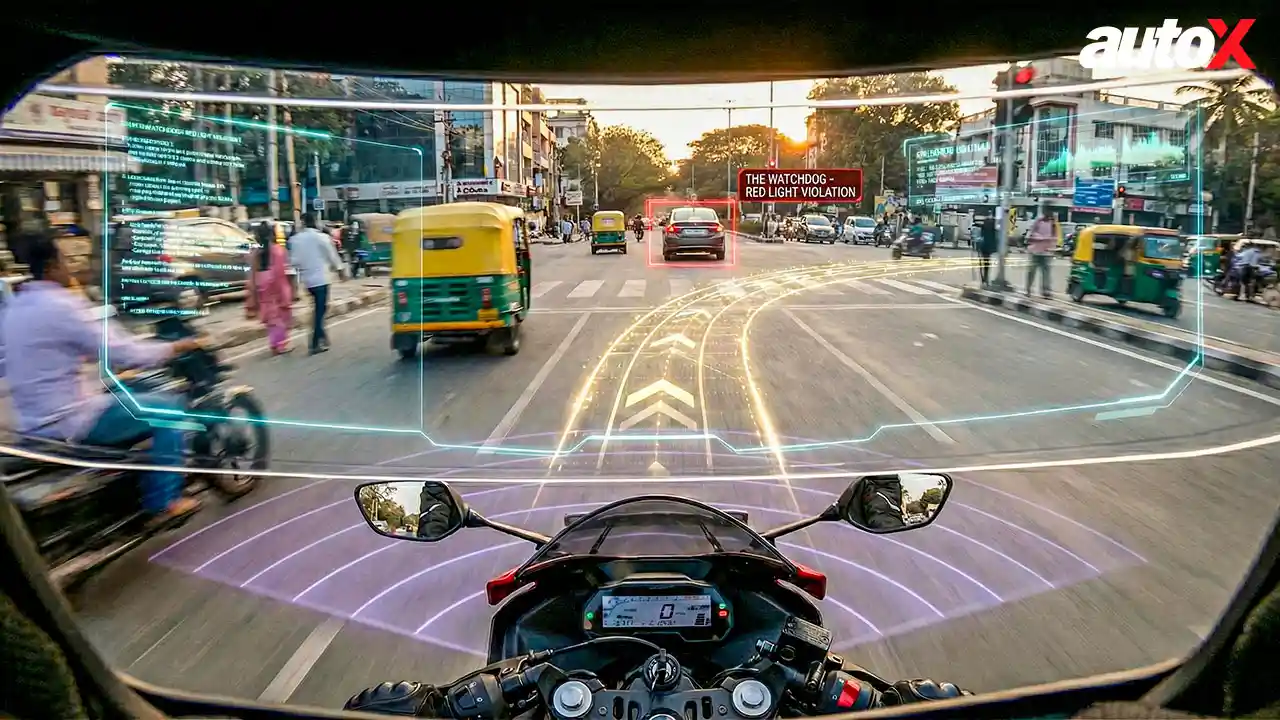
For over a century, the motorcycle stood for analogue purity, but that era has ended. And what made us stand up and take notice didn’t originate in a European R&D facility, but in the chaotic crucible of Bengaluru traffic. There, Pankaj Tanwar, a software engineer, has democratised code against chaos. Retrofitting his helmet with a Logitech webcam and a Raspberry Pi, he created a mobile enforcement unit. Using YOLO computer vision models, his system detects wrong-way driving, red-light jumping, and no-helmet riding in real time.
What elevates this is the verification layer: onboard system flags issues, which are then verified by LLMs like Gemini or ChatGPT to ensure a 96% confidence score before reporting. Paired with initiatives like Delhi’s Traffic Prahari app, which gamifies reporting with cash prizes, the rider is transformed from a passive participant into an AI-augmented sentinel.
This cognitive shift echoes through the industry. Giants like Ducati and KTM have integrated Bosch’s radar-based Advanced Rider Assistance Systems (ARAS). These machines now possess an invisible ‘sixth sense,’ scanning the road with millimetre-wave radar to manage adaptive cruise control and blind-spot detection. Even our gear has gained consciousness. The ‘algorithmic airbag’ from Dainese and In&motion rely on predictive neural networks rather than physical tethers. Monitoring kinematics 1,000 times per second, these wearable brains distinguish between a harmless stumble and a high-side crash with precognitive-like accuracy.
Beyond safety, the soul of the ride is being curated by AI. Apps like Calimoto reject the efficiency-first logic of standard GPS, analysing road geometry to generate routes based on ‘curvature scores’ for the most euphoric tarmac. When the ride ends, AI serves as a pocket mechanic. Apps like AutoSonic analyse engine acoustic signatures to diagnose faults like loose valves, while new OBD-II tools translate sensor data into plain human language.
This is a complete redefinition of motorcycling as we know it. We are witnessing the birth of the augmented rider, where safety, navigation, and accountability are handled by an invisible, intelligent companion.