Ultraviolette X-47 Factory Tour - Coming Full Circle
We swap riding gear for tools at Ultraviolette’s factory, joining the assembly line to see how the new X-47 crossover electric bike is built from the ground up.
By Aryan Aggarwal

There was a time when I thought I would grow up to be an engineer, spending my days around cars. Life, as it often does, had other plans. The good news is that I still found my way into the world of machines, albeit in a different way.
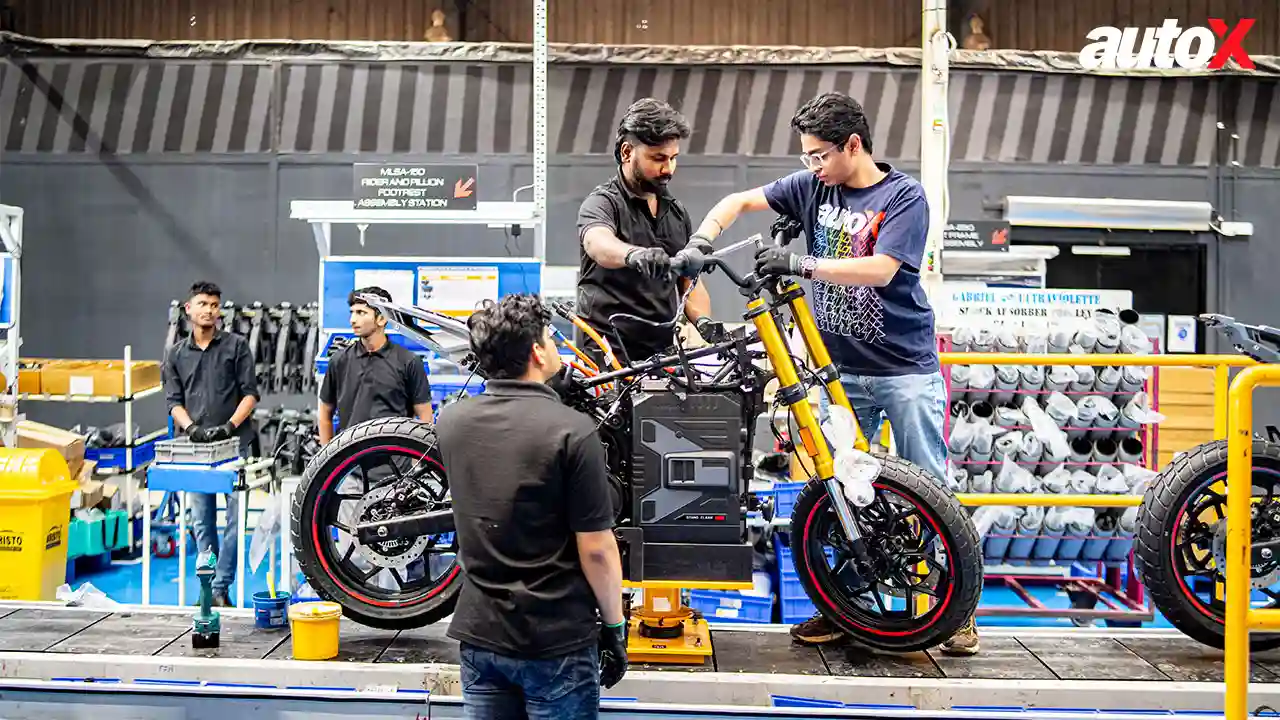
Why the preamble, you ask? Well, because when Ultraviolette invited us to their factory, my inner engineer was immediately piqued. But my excitement went into overdrive when we were told we wouldn’t be there just as spectators – we would also step onto the assembly lines ourselves, putting together the X-47 crossover step-by-step.
So, how is an electric bike actually made? It begins at the battery line. Here, outsourced cells are meticulously arranged into proprietary battery packs within a strictly controlled environment. Ultraviolette prides itself on its industry-leading battery technology and state-of-the-art thermal management. Instead of standard surface cooling, their system utilises both base and top cooling, ensuring significantly more effective and rapid heat dissipation.
Once the battery packs pass their quality checks, they are moved to the sub-assembly line – a series of specialised stations for different stages of the assembly. This is where our hands-on experience truly began. We started by putting the motor and the battery pack together, before fitting the entire assembly into the bike’s frame. Once the wheels, after being balanced, are attached, the core of the X-47 finally begins to take a recognisable shape.
Next, the upper triple clamp, handlebars, ADAS radar, onboard charger, Motor Control Unit (MCU), and Vehicle Control Unit (VCU) are installed. You can see the full, step-by-step process of us putting the bike together on our YouTube channel.
Stringent quality checks are carried out at every stage of the process. As Niraj Rajmohan, CTO at Ultraviolette Automotive, explained, identifying a fault as early as possible is critical to minimising losses; rectifying an issue becomes exponentially more complex and costly the further a bike progresses down the line.
With the mechanical and electrical internals secured, the focus shifts to the final aesthetics. Body panels are meticulously checked for decal alignment before being fixed to the frame one by one. The motorcycle then undergoes a preliminary ‘T-1’ inspection designed to identify any lingering fitment issues or lapses in electrical integrity.
Then comes the dyno test. This was one of the only two stages—along with the initial battery assembly—where we were relegated to being spectators rather than participants. Here, throttle response, braking, and electronics are validated across all ride modes.
After the dyno, it’s time for radar calibration, which was perhaps the most fascinating stage of the entire assembly. Inside an anechoic chamber, the radar emits a wave at a reflective metal plate; the signal bounces back, and within a mere three seconds, the system is perfectly calibrated.
Finally, the bike passes through a brightly lit chamber with an array of tube lights, making any marks or irregularities visible. All mechanical, electrical, and cosmetic checks are performed here one last time. If the bike passes all of them, it’s rolled off the assembly line, ready to make its way to the warehouse.
It was an incredible experience, to say the least. What fascinated me most was how Ultraviolette, a relatively young manufacturer, has established such an impressive facility with clearly defined workflows and robust quality gates. The team works in perfect harmony to assemble up to 40 motorcycles a day from this facility.
A word of warning, though: your next motorcycle might just have been assembled by an unassuming journalist-turned-mechanic. If you find a loose screw, you’ll know exactly who to blame, and it certainly won’t be Ultraviolette.