Can AI Technology Finally Tackle the Two-Wheeler Fatality Crisis in India?
Crash data reveals that the biggest chunk of fatalities on Indian roads were of two-wheeler riders. Can AI-powered ADAS/AD come to their rescue? Srini uncovers another promising startup.
By Srinivas Krishnan

Over 45% of the 173,000 lives lost on Indian roads in 2023 were of two-wheeler riders. They are the largest category of road users who perish on our roads; pedestrians are second, at a distant 20%. I’ve written about this before, on how the narrative on road safety is dominated by passenger cars – do you think two-wheelers command a proportionate 45% of all conversations on road safety? I think not. Isn’t it bizarre that the people who are in charge of reducing road fatalities in the largest two-wheeler market in the world are not giving this issue the attention it deserves?
Well, at least someone is. These disproportionate deaths have not gone unnoticed in some startups in Bengaluru (and in some prestigious academic institutes in other parts of the country). And also, thankfully, at two-wheeler OEMs. Something is brewing, and it has something to do with cutting-edge technology.
Last month, I wrote about a fascinating startup that’s developing foundational models for Advanced Driver Assistance Systems/Autonomous Driving, which are more in tune with Indian driving conditions. If you missed it, scan the QR code at the end of the article to read it online, as it has a link to what follows.
Prakhar Agarwal is the co-founder of BYTES, which says it is India’s first startup building AI-powered ADAS for safer two-wheeler mobility. Well, it’s more ARAS than ADAS, according to me, but I think Continental has patented the abbreviation. Anyway. Prakhar and his co-founder used to work at Minus Zero – yes, the same ADAS/AD startup that I wrote about previously – but parted ways to set up BYTES. Prakhar reached out after reading it to tell me about what he and his team are doing, and I think it’s vital that more people know about it.
Prakhar is an avid biker and has even done a stint aboard his KTM 390 Adventure from Kanyakumari to Kashmir. While meeting and talking to fellow bikers, he could empathise with the problems urban commuters and highway riders were facing, both distinctive and unique, but serious issues nevertheless. Being aware of the higher fatalities of two-wheeler riders, he figured something needed to be done.
"To solve this, we’ve been building a combination of passive alerts and active assistance features tailored for two-wheelers. For example, our Predictive Collision Alert – a passive feature – warns the rider of imminent obstacles or vehicles before ignition or initial movement, thereby enhancing situational awareness right from the start. On the active side, one of our core innovations is Dynamic Cruise Control. Conventional systems simply lock onto the nearest vehicle ahead, which as we know, can often switch lanes or brake unpredictably. Instead, our DCC continuously analyses the environment and adapts in real-time to the movement of multiple surrounding vehicles, making it more suited for chaotic urban driving conditions," he says.
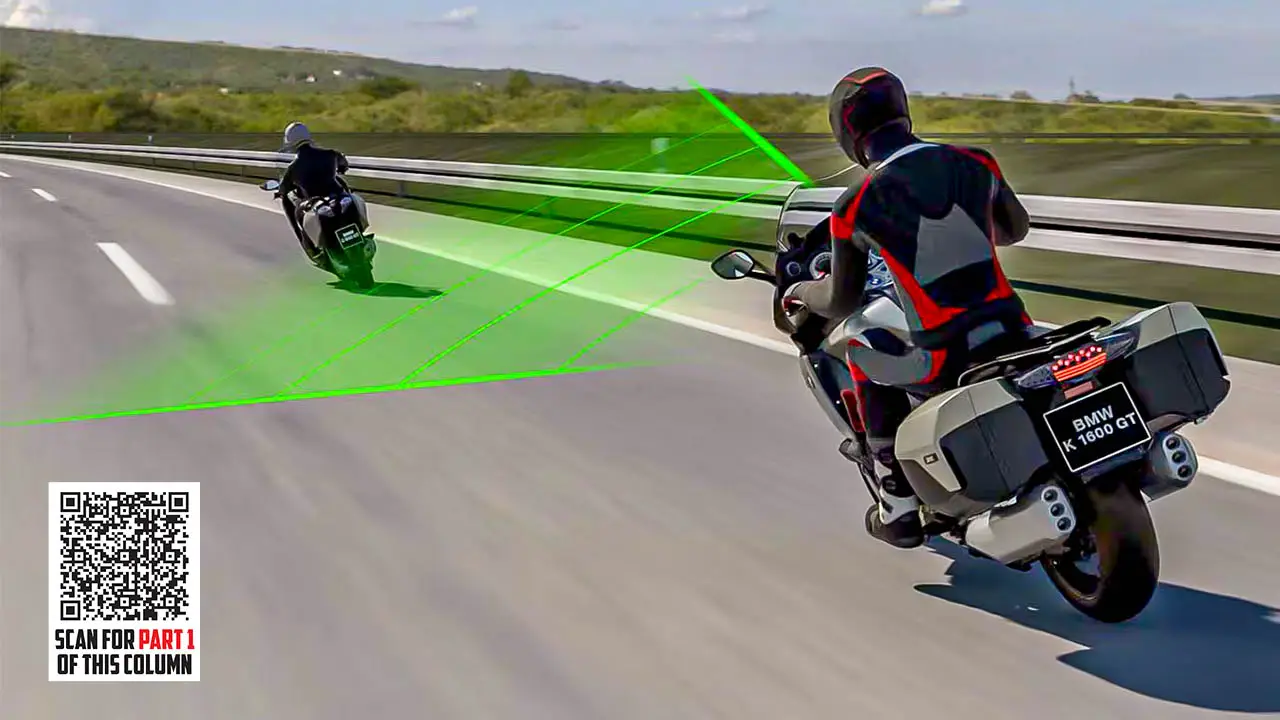
"Conventionally, ADAS keeps beeping, you get robotic, rule-based alerts simply because sensors detect proximity. We are not doing that. As a normal rider, you judge whether something is a threat based on its trajectory and context. That’s exactly what our algorithms are built to replicate. The rider is in motion, the surrounding agents are in motion, and the situation is constantly evolving. Our threat analysis, therefore, divides the road into dynamic grids and processes how many of those grids are occupied by potential threats, alerting the rider only when it truly matters."
BYTES caters to the unstructured environment of India. For example, most two-wheelers cut very close in front of other vehicles while overtaking or closely tailgate the vehicle in front. The system is trained not to give false alerts, but does so only when a collision is likely. In other words, no intrusive warnings when you are overtaking dangerously, because it knows that’s the way you ride and doesn’t disturb you when you are executing the manoeuvre. "We’ve designed our alerts to be precise and meaningful, timed to intervene only when they can truly prevent an accident and save a life," he says.
"We work on purely vision-based technology, as cameras perform best in most conditions except in rare cases of zero visibility, like extreme fog. That’s where our advanced AI models and fallback systems step in," he says. "Whether it’s riding in the rain, navigating potholes, or facing dense fog and night-time conditions, the system relies on deep semantic understanding of the scene to provide accurate, timely alerts, ensuring the rider stays informed and safe, even in edge cases."
But are two-wheeler OEMS interested? Prakhar says, "OEMs are excited and enthusiastic, despite India being a price-sensitive market. We are already working with multiple OEMs across the spectrum, including both legacy players and new-age electric startups, many of whom have directly reached out to us to understand our technology and explore collaboration opportunities. In India, OEMs are actively looking to introduce technologies that can be democratised across segments, and safety-led innovation is gaining strong momentum. For example, with ABS, it is possible to install it across a wide price range. But ADAS today caters to a specific segment – one lakh rupees upwards – where many OEMs don’t have volumes. It is difficult for them, with a limited number of SKUs to endure cost and time overruns to develop this technology. That’s why we are their technology partners."
What about customers? Are they keen? While the Government has recently mandated ABS for all two-wheelers, not just for premium models, most users may not know how ABS works – that it prevents skids and the brakes from locking up during emergency braking manoeuvers, giving you the chance to retain control, as opposed to helping you come to a sureshot halt. I think customer education is as important as the technology that has been made mandatory. But this is just an aside. Going back to Prakhar, "We have researched whether riders will opt for ADAS. They are aware of the term but are not aware of what features it comes with or what it implies, but they know it is something to do with safety." Yes, education is key, then. Hope the Ministry and OEMs do something about it, instead of merely making it mandatory, incorporating it and thinking their jobs are done.
Currently, BYTES is exploring opportunities with fleet operator companies to collect data on scale, which will offer their model a rich vein of diversified data to train on. But unlike passenger vehicles, there is a staggering variety of two-wheelers, so how will the system adapt? "Different form factors mean different riding behaviours. Like you’d lean in with a sport bike, but not with a Scooty. Or that you hold an adventure bike with your thighs. There are multiple ways to handle a two-wheeler, but the model can be generalised on how a two-wheeler should behave," he says. He also adds, "Two-wheelers are, and will be, important for India, for the foreseeable future. Everyone has a friend or family member affected by an incident with a two-wheeler; therefore, road safety for two-wheelers should be everyone’s concern." Yes, EVERYONE.