TVS Apache RTR 310 First Ride Review - Built SmaRTR
What happens when you pack even more tech to one of the most advanced 300cc motorcycles on the market?-Before the market was flooded with budget-friendly 400cc motorcycles,
By Aakash S Paul
Photography By Sunil Chauhan

Before the market was flooded with budget-friendly 400cc motorcycles, one of the best performance bikes you could get without breaking the bank was the TVS Apache RR 310. It was TVS’s largest-displacement offering, showcasing the company’s racing pedigree to the fullest.
Then came the RR’s naked sibling – the RTR 310. By then, however, the market had changed, and competition had grown fiercer. While the RTR 310 doesn’t have the edge in terms of displacement, it more than makes up for it with a tech-loaded arsenal.
Now, the 2025 update pushes that envelope even further. We took the bike for a spin on the streets of Coimbatore and the CoASTT track to find out how this refreshed package holds up.
TVS Apache RTR 310 Design Upgrades
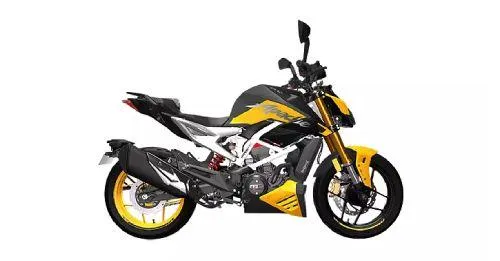
The new RTR sees more cosmetic updates than mechanical ones. The first thing you’ll notice is the updated graphics. There are four colour options to choose from, and I must say that all of them look stylish. My personal favourite is the Arsenal Black.
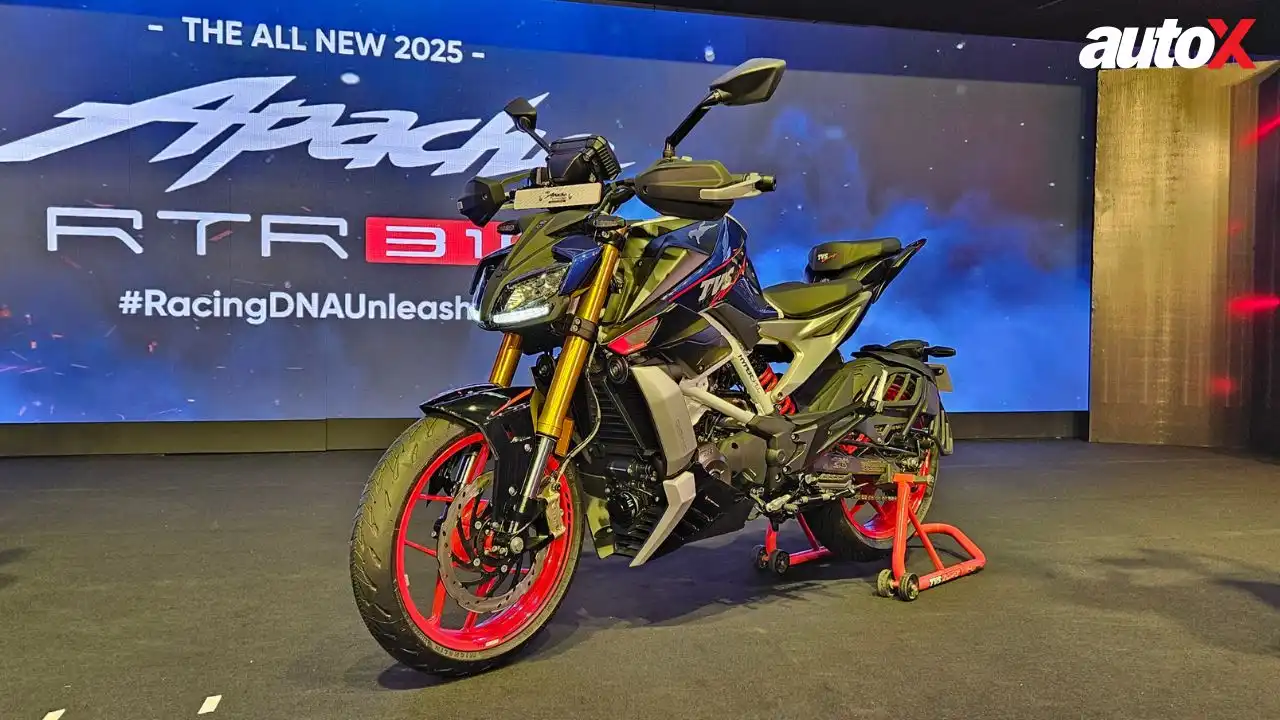
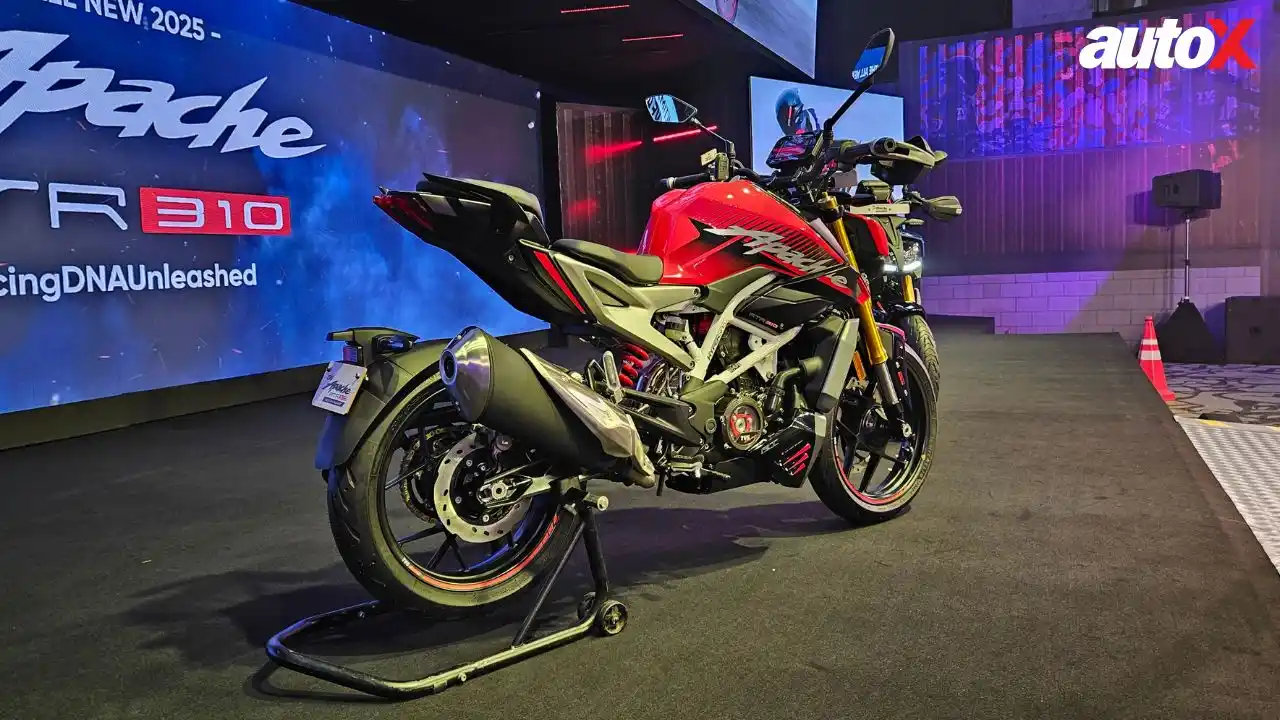
Much like the updated RR 310, the RTR now features a transparent clutch cover – a pretty cool addition. The bike also gets plastic handguards, directional turn indicators, and a keyless ignition. That said, I noticed that the animation effect on the turn indicators is difficult to spot from most angles, which makes this particular feature almost ineffective. While the RTR 310 still looks stunning, I do wish that TVS had addressed the exhaust design – it feels like a missed opportunity.
TVS Apache RTR 310 Engine and Safety
At the heart of the RTR 310 is the same 312.2cc single-cylinder, liquid-cooled engine, producing the same power and torque figures as before. What has changed, however, is the engine mapping.

The RTR 310 has always been a fast and engaging machine, but at low speeds, its jerky throttle response made it a bit of a handful. That issue has now been addressed, thanks to the revised tuning. Twist the throttle, and the power delivery feels noticeably smoother and more predictable, without dulling the bike’s spirited character.
TVS hasn’t made much noise about it, but the engine vibrations also feel slightly more refined. Vibrations aren’t as harsh as before, and the bike feels more settled and composed in the 4,000 – 5,500rpm range. As a result, highway cruising is now a noticeably more pleasant experience.

TVS has also added launch control to the electronics package – a feature typically found on high-end litre-class bikes. It helps keep the front wheel planted on the ground when you dump the clutch and twist the throttle with reckless enthusiasm. While it’s definitely a cool addition, its real-world usefulness is quite limited.
A more helpful electronic aid is the Drag Torque Control, which helps modulate engine rpm during aggressive downshifts to keep the rear wheel in check. It is meant to make the bike more forgiving under hard riding, especially when charging into corners on a race track. However, during my laps around CoASTT on the updated RTR 310, I did not notice a dramatic difference. That’s not to say the bike is no fun on the track – far from it.
TVS Apache RTR 310 Review Conclusion - Built to Outperform?
The 2025 Apache RTR 310 is undeniably one of the most technologically advanced motorcycles in the segment, thanks to its comprehensive electronics package. The only issue is that most riders will rarely find a situation in day-to-day use that actually demands these high-end features.
TVS has dropped the introductory prices for the base and top variants by ₹10,000. The BTO trim’s price, however, has increased by ₹3,000. So, if you opt for a non-BTO variant, you’ll now get better throttle response, Drag Torque Control, and a few cosmetic tweaks.
That said, I feel that in today’s competitive market, the new RTR 310 needed either more meaningful updates or a lower price tag to earn an easy recommendation. As it stands, you’d buy this bike mainly for its uniqueness. It’s still a solid package – no doubt about it – but TVS seems to have missed an opportunity to make it a much more appealing choice in the current landscape.
Engine: 312.2cc Single-Cylinder
Transmission: 6-Speed
Power: 35bhp
Torque: 28.7Nm
Fuel: Petrol
Price: ₹2.85 Lakh Ex showroom
X-Factor: A 300cc bike equipped with a litre-class electronics package.
|
Pros |
Cons |