Skoda Kodiaq First Drive Review - Setting a Benchmark
With the launch of the second-gen Kodiaq, Skoda brings Indian buyers a fresh contender in the three-row SUV space. But is it worth it?
By Ishan Raghava
Photography By Sunil Chauhan

We’ve waited long enough for the new-generation Skoda Kodiaq to finally make its way to India. The Kodiaq has always been the thinking person’s luxury SUV, offering a European luxury car feel at a more accessible price point, executed in typical Skoda fashion – balancing practicality with a solid driving experience. But how much of it remains in this new version?
New Skoda Kodiaq Design & Dimensions
The latest Skoda Kodiaq definitely takes a more extroverted approach, while still exuding a premium appeal. Though it’s unmistakably a Kodiaq, the wider grille, along with the light bar in this L&K version, gives it a distinctive edge. The tiered lighting is now more prominent, and when driving at night, it’s about as effective as one would like it to be.

This more aggressive look of the new Kodiaq is enhanced by its sharper design. The bonnet and bumpers are more angular and pronounced, not just for aesthetics but also for practical aspects – the drag coefficient has gone down from 0.33 to 0.28, adding to the efficiency of the SUV.
In terms of size, the only dimensional change is that the Kodiaq is now 59mm longer. The side profile now has a longer silhouette, with a neat kink under the D-pillar. The 18-inch wheels remain unchanged, though they continue to be well-proportioned. However, we do miss a more traditional alloy design; the current aero-style wheels are chosen primarily for efficiency.
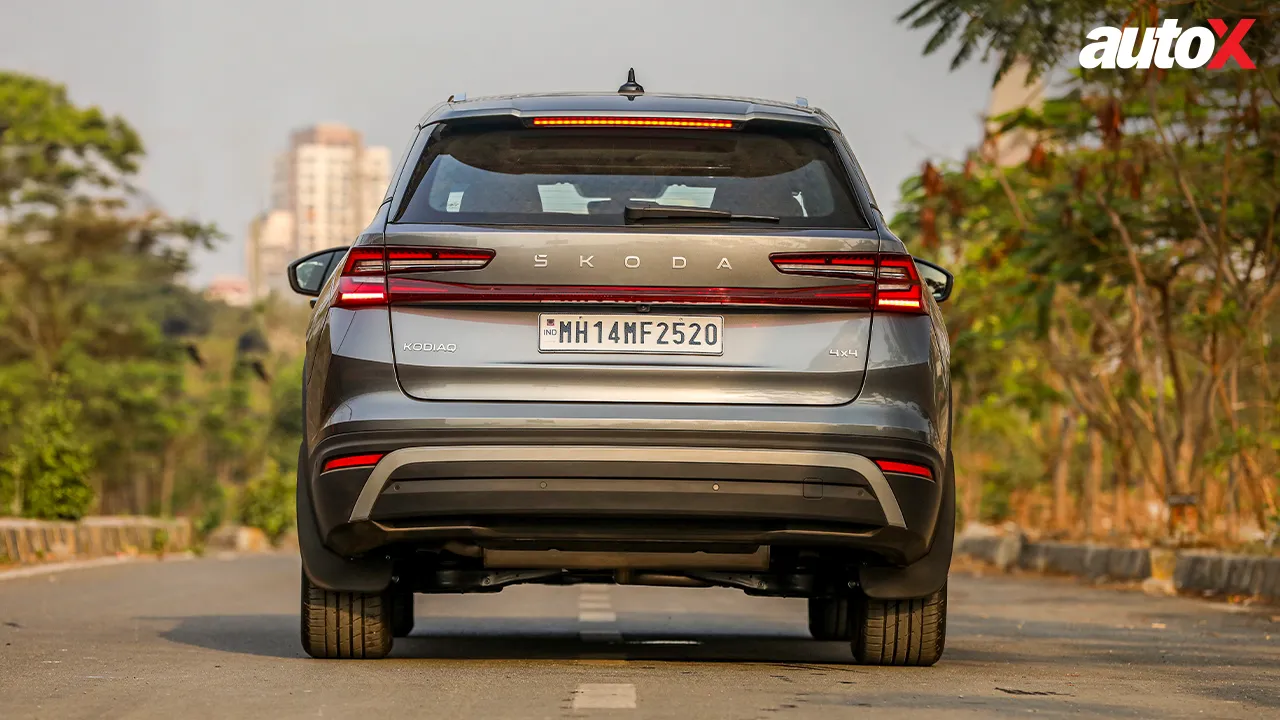
At the rear, the Kodiaq’s familiar design continues but with some updates – a sharply angled windscreen and sculpted bodywork make it sportier. The lighting, too, adopts a more prominent version of Skoda’s signature C-motifs, although you won’t find the full-width setup seen in some rivals.
A benefit of the extended length is an addition to the boot space. With all three rows up, capacity has grown by 11 litres, now offering 281 litres of space.

Fold the third row, and this expands to a generous 786 litres – 21 litres more than before. Despite the manual folding mechanisms for the second and third rows, accessing all this space is easy enough, especially with the pull-tabs for the second row in the boot, which allow you to create 1,976 litres of space.
New Kodiaq Interior Quality & Space
Inside, the new Kodiaq exhibits a more substantial departure from its predecessor. The dual-cockpit theme stands out, and at first glance, it feels considerably more upmarket than the simpler design of the earlier model.

The tan leather on the dash, is a massive upgrade, and most surfaces have a soft, premium feel to them. The more intricate air vents and the floating effect of the door handles make the interior feel even more premium. What hasn’t been compromised, however, are the thoughtful touches Skoda calls their ‘Simply Clever’ features. One standout feature are the configurable dials. These rotary controls serve multiple functions, managing climate, seat, and drive modes, offering a far more intuitive and easier to use alternative to touch-based interfaces.
Another practical addition is the new central tunnel. With Skoda shifting to a column-mounted gearshifter, the Kodiaq’s cabin feels more spacious and less cluttered, even though the overall space remains unchanged from the previous model.

The switch to the updated MQB platform also brings new electronic architecture – the car now gets a 13-inch touchscreen and a 10.25-inch driver’s display. The touchscreen supports seamless wireless Android Auto and Apple CarPlay, along with built-in navigation.
In the second row, while the changes aren’t massive, there’s a greater sense of space and comfort. The door protectors remain, as do the three-zone climate control, large panoramic sunroof, and window blinds.

The third row has also received attention, with 15mm of extra headroom, but the experience remains much the same as in the previous Kodiaq. It’s still best suited for children – most adults will find it tough to sit here for long periods. As a result, the third row should be used only by children or for short journeys. In fact, the massive boot space you get when the third row is folded is much more practical.
2025 Kodiaq Features & Safety
Like before, the Kodiaq comes generously equipped. Highlights include matrix LED headlamps, automatic headlights and wipers, powered front seats with heating, ventilation, and massage functions, three-zone climate control, a panoramic sunroof, and rear window blinds.

Safety features continue to impress with nine airbags – though now, a centre airbag replaces the driver’s knee airbag. The Kodiaq retains its 5-star Euro NCAP rating, but, ADAS is missing from the India-spec version.
New Kodiaq Engine, Power & Driving Experience
From behind the wheel, the experience doesn’t feel drastically different at first. It’s easy to find a comfortable driving position, the SUV feels smaller than its size when manoeuvring, and the seats are very comfortable. The 2.0-litre turbo-petrol engine, now producing 201bhp, is a significant upgrade.

It continues to make 320Nm of torque and is paired with a seven-speed DCT, but its drivability is remarkably better. This sense of improved response carries through the rev range, where a linear surge of power makes acceleration feel more intuitive. As before, performance ramps up significantly past 4,000rpm, but it’s now accompanied by a more engaging rasp from the engine.
The new Kodiaq rides much like its predecessor. On smooth roads, it glides along with a composed presence that delivers a genuine luxury car experience. However, over broken and uneven roads, the suspension becomes quite noisy, and at low speeds, sharp bumps can filter into the cabin. As before, though, the ride improves noticeably as speeds rise. The Kodiaq settles into a confident, comfortable pace that makes rear-seat travel particularly soothing.
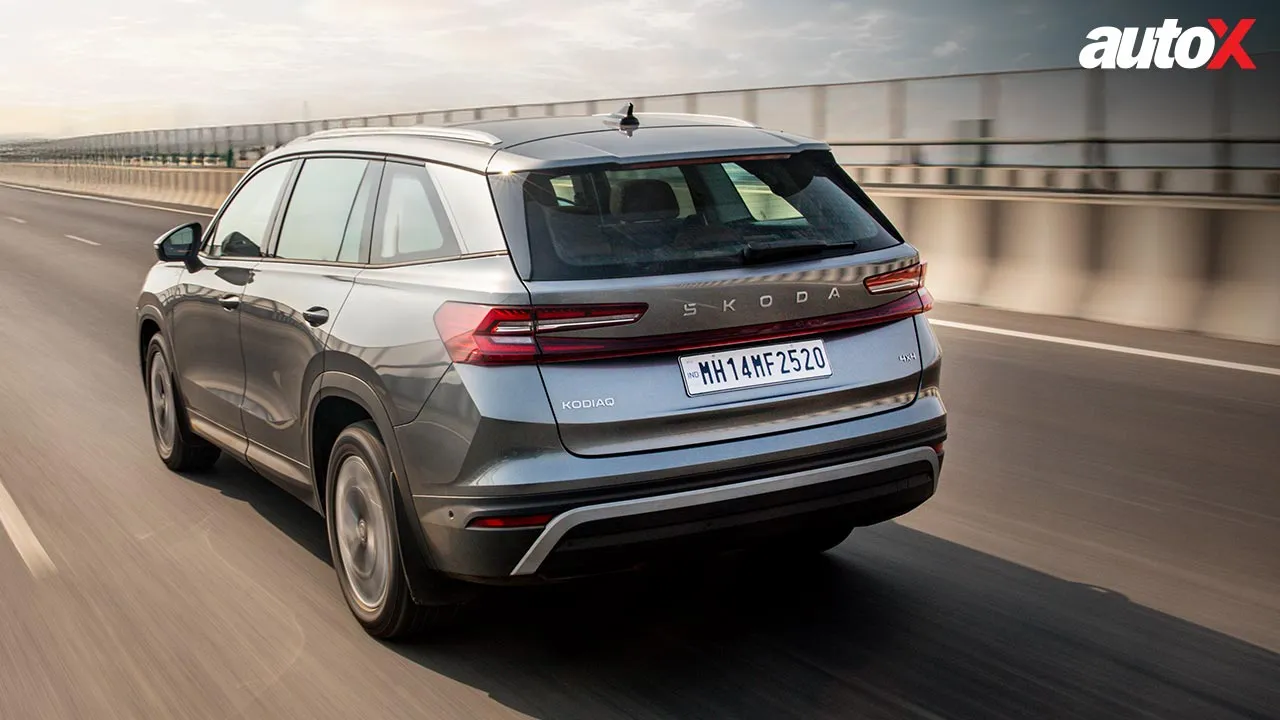
Despite the removal of the adaptive damping system in this update, the Kodiaq maintains good ride quality over most surfaces at higher speeds. That said, when pushed hard, its mass does begin to show. In tighter corners, it rolls and runs wide, but keep your speed and inputs measured, and the Kodiaq will flow along a winding road with decent agility and a touch of engagement.
The steering contributes positively to this experience – it’s light enough to make city driving feel easy, yet precise enough at higher speeds to inspire confidence, giving you a sense of control. Also worth noting is the improvement to the braking feel: gone is the abrupt pedal response seen in earlier Skodas. Braking now feels more progressive, allowing you to modulate the brakes better.
2025 Skoda Kodiaq Price & Verdict: Is It Worth the Premium?
Priced at ₹48.69 lakh for this L&K version, the new Kodiaq picks up right where the previous model left off. It has gotten significantly more expensive, and while the infotainment screen could be more intuitive and some plastic bits don’t feel as premium as before, the overall cabin feels more special nonetheless. The smoother, more refined engine and well-sorted dynamics continue to make this a genuine luxury experience, without a luxury price tag.

Engine: 1,984cc 4-Cylinder
Transmission: 7-Speed DSG AWD
Power: 201bhp
Torque: 320Nm
Fuel: Petrol
Price: ₹48.69 Lakh Ex showroom
X-Factor: If you’re looking for a fun-to-drive three-row, premium SUV, nothing beats the Kodiaq!
|
Pros |
Cons |