New Renault Duster 7-Seater (Dacia Bigster) Gets 3-Star Safety Rating from Euro NCAP
The Dacia Bigster scored 38.2 points (60%) in vulnerable road user safety tests and 10.3 points (57%) in safety assist tests. Read on for more details.
By Sanorita

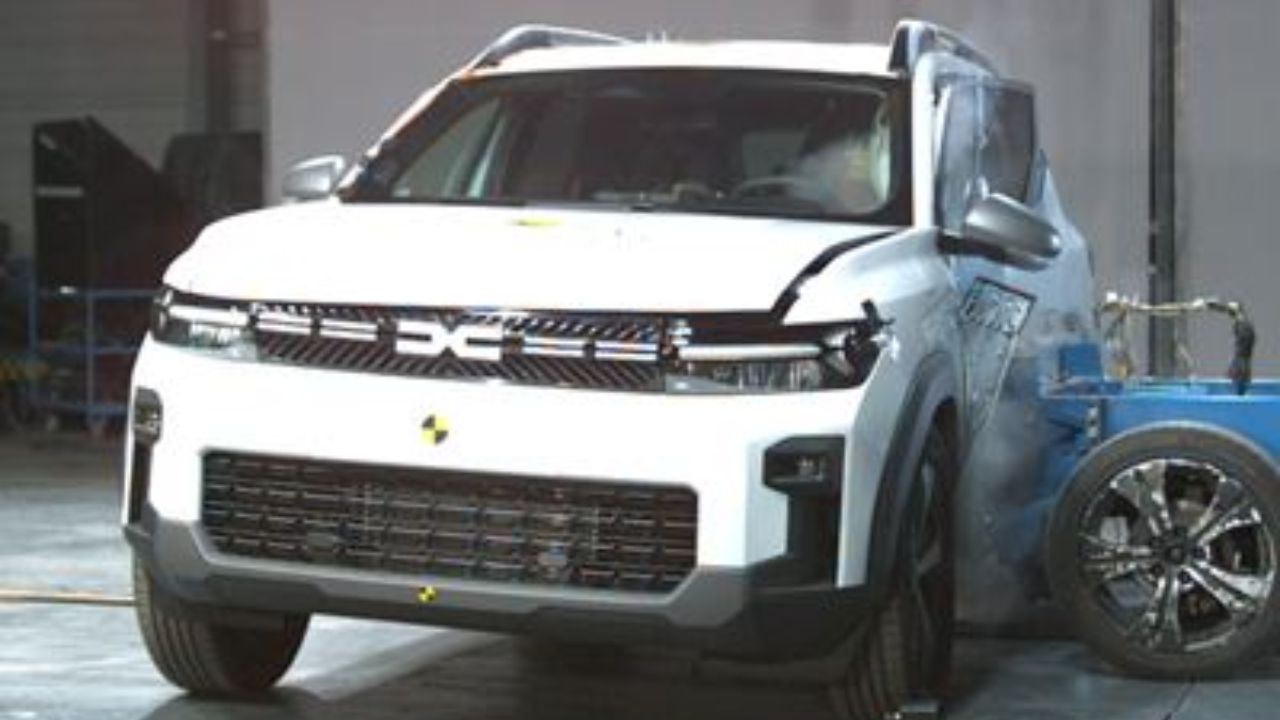
The Dacia Bigster, which debuted globally last year, has received a 3-star safety rating from Euro NCAP. The three-row SUV, a larger version of the Duster, is expected to launch in India in 2026 under the name Renault Boreal. In crash testing, the Bigster scored 69% (27.7 points) for adult occupant protection and 85% (42 points) for child occupant safety. Euro NCAP reported the vehicle's passenger compartment was stable in the frontal offset crash, offering good protection for knees and femurs for both front occupants. This protection was consistent regardless of occupant size or seating. A notable concern was weak driver chest protection, based on dummy readings. Interestingly, analysis also suggests the Bigster would be a less damaging vehicle in a head-on crash with another car.
In the full-width rigid barrier test, the Dacia Bigster showed marginal chest protection for both the driver and rear passenger, according to dummy compression data. However, in side-impact evaluations, including the standard side barrier and the more demanding side pole test, the SUV performed well, offering good protection to all key body regions and earning full marks in this area. That said, Dacia did not supply data to verify how effectively the Bigster limits occupant movement across the cabin in far-side impacts, leaving some uncertainty in this aspect of crash performance.
Also Read: Renault Confirms Name ‘Boreal’ for Upcoming 7-seater SUV – Here’s What to Expect
The Dacia Bigster falls behind in far-side impact protection due to the absence of a system designed to prevent head-to-head contact between front-seat passengers, resulting in a poor safety rating for this aspect. However, it excels in whiplash protection. Both the front seats and head restraints were tested and showed strong performance in rear-end crash scenarios, providing good protection. Whiplash protection for rear passengers was assessed as strong. The Bigster's safety extends beyond crash tests. It features an advanced eCall system for automatic emergency contact post-collision. Importantly, Dacia verified the doors function even with power loss, critical for emergencies like submersion. A system to prevent secondary collisions is also included, aiming to minimise additional harm after an initial impact.
Dacia Bigster: Other Highlights
The Dacia Bigster, set to be launched as the Renault Boreal in India by 2026, sports a unique design and advanced features. In Europe, it comes equipped with a range of driver-assist functions, including Autonomous Emergency Braking and a Driver Fatigue Alert system, as well as six airbags as standard. The Bigster’s design features a front end resembling the Dacia Duster, with sharp LED headlights and a clean grille without the plastic cladding seen on the Duster. Its side profile is marked by 19-inch dual-tone alloy wheels, hexagonal wheel arches, and black body cladding, while turn indicators are integrated into the side mirrors.
Also Read: Renault 5 Turbo 3E Electric Mini-Supercar Breaks Cover
The rear features V-shaped LED tail lights, “Dacia” lettering, and a sturdy rear bumper with a carbon-fibre strip. Silver roof rails and optional black roof styling enhance the car’s visual appeal.
-1773732078827.webp "Renault Duster Hybrid Version Sold Out for 2026; Bookings Closed Temporarily")