Suzuki Avenis 125 vs TVS Ntorq 125: Comparison
On paper, the Suzuki Avenis 125 is pretty much neck and neck with the TVS Ntorq 125. But are these scooters really that similar to each other even when it comes to the riding experience? To find out, we took them both out for a day.
By Divyank K. Bansal

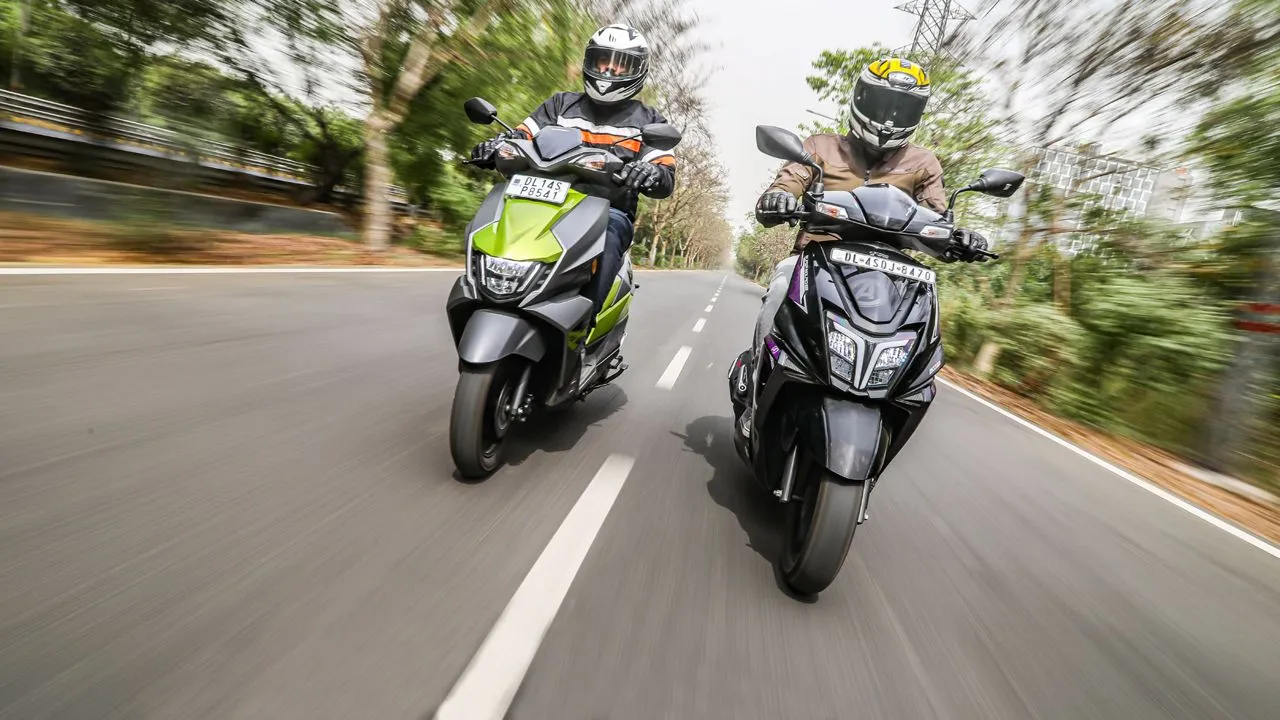
On paper, the new Suzuki Avenis 125 is pretty much neck and neck with the TVS Ntorq 125. So, is there more to this comparison than meets the eye?
For someone who started riding on a 110cc scooter, I’ve always had a bit of a soft spot for the newer 125cc scooters. I know, it sounds quite bizarre. Because, to be honest, there isn’t much difference except for a bit more performance from the latter. But that’s the thing. Only a college kid who has spent his graduation years scooting around on a 110cc scooter can perhaps best describe the importance of that extra power. But for the sake of explaining it as clearly as I can, a 110cc scooter is like a bowl of Maggi noodles. Nothing wrong with it and just as enticing as ever. But a 125cc scooter is like a bowl of Maggi noodles with a big dollop of butter on top! See where I’m going with this? It’s that dollop of ‘extra niceness’ that makes the difference.

Speaking of 125cc scooters, of late, TVS has been enjoying great success in the segment with its Ntorq 125 – so much so that it would not be wrong to call it the undisputed king of the segment. Of course, when you have a product as successful as the Ntorq, naturally, other manufacturers are bound to be intimidated by it, to the extent that they’d pretty much go to any lengths to get a piece of the action. Case in point – the Suzuki Avenis 125. A few months ago, Suzuki launched the Avenis 125 in India and almost immediately, we knew its direct rival. How? Well, park the Avenis next to the Ntorq and you will understand why! I’m not saying that they’re carbon copies of each other, but examine the overall shape of some of the key body panels and you’ll see the uncanny resemblance. I feel that both scooters even have a superimposable silhouette!

And this isn’t where the similarities end! Open up the spec-sheets of both these scooters and on paper too, they’re neck and neck. The Ntorq is slightly more powerful and torquier, the Avenis offers a bit more ground clearance. The Ntorq offers a slightly larger fuel tank, the Avenis is the lighter of the two. In pretty much all comparison aspects, both scooters are quite evenly matched, going one-up on each other by a hair’s width. So, this got me thinking. Are these scooters really that similar to each other even when it comes to the riding experience? And are these two perhaps the best 125cc scooters currently on sale? To find out, I took them both out for a day.
Engine & Performance
Without further ado, I’ll straight away get to the performance and riding experience. The Ntorq features the signature TVS hallmarks – a smooth and refined engine, exemplary power and torque distribution, no lack of performance and sorted ergonomics. The 125cc CVTi Revv motor is quite hard to fault and it delivers performance in a very balanced manner. Plus, because it features three valves (compared to the Avenis’ two-valve setup), the extra valve helps in more efficient combustion that translates into more performance, and it’s not a gimmick. You do sense this benefit while riding. Compared to the Avenis, the Ntorq offers more power and torque – 9.25bhp @ 7,000rpm and 10.5Nm @ 5,500rpm.

The Avenis, meanwhile, features a standard single-cylinder air-cooled setup and the 125cc motor develops a reasonable 8.6bhp @ 6,750rpm and 10Nm @ 5,500rpm. So, you must be thinking that the Ntorq is hands down the better performer of the two? Not exactly. You see, Suzuki has given the Avenis a pretty substantial weight advantage – it tips the scales at just 106kgs. In comparison, the Ntorq weighs 118kgs. And this 12kgs difference is what makes the Avenis the peppier scooter of the two. During off the line acceleration, the Avenis feels much quicker and climbs up to 50km/h quite well. However, beyond this speed, the progress is quite leisurely and you sense that the engine has run out of steam. This is where the Ntorq gains an advantage. Thanks to that extra valve and more power, the Ntorq climbs up to its top speed in a more determined manner without gasping for breath.

Ride & Handling
The Avenis’ lower weight also makes it nimbler around bends. Add to this good suspension that tackles bad roads and potholes with aplomb, and progressive braking, and what you get is a lightweight scooter that is very enjoyable to ride at average city speeds. The only downside I’d like to mention here is the Avenis’ riding posture. The seat tapers a bit too sharply towards the rider’s end, which leads to a sitting posture with the knees pointing out. It does not feel very organic and you find yourself consciously pulling your knees in for that neutral riding posture.

The Ntorq, on the other hand, offers a much more neutral riding position and the seat offers appreciable support. While the Ntorq’s suspension is quite evenly matched to that of the Avenis, the former does lose a few points for braking feel. The Ntorq’s braking, though effective, does not offer much feel from the levers due to which the brakes feel quite wooden. Handling-wise, the Ntorq’s additional weight and wider tyres provide a more stable and sure-footed feel around corners.
Ergonomics & Features
At 160mm, the Avenis offers a few more millimetres of ground clearance, and, at 21.8 litres, it also offers more under-seat storage than the Ntorq (20 litres). But with a larger 5.8-litre fuel tank, the Ntorq will offer marginally more riding range than its rival (5.2-litre). Both scooters also offer appreciable build quality, although the Ntorq features slightly better-looking black plastic panels.

In terms of features too, the Avenis and Ntorq are pretty much cut from the same cloth. Both get Bluetooth connectivity (via smartphone app) and a Bluetooth-enabled digital instrument cluster, alloy wheels, LED lighting, external fuel filler cap, USB charging socket, telescopic front suspension, and more. The Avenis, though, gets one or two more premium features, such as a side-stand inhibitor and a one-touch silent electric starter.

A Clear Winner?
So, after spending an entire day riding both these scooters, I can definitely say that the Avenis and Ntorq offer a fairly different riding experience, which is a good thing if you have to choose between the two. But if I look at the pricing, the Avenis starts from ₹86,500 and the Ntorq range starts from about ₹77,100. Of course, the versions of both these scooters which we used in our test are similarly priced, but because of this gap, the Ntorq offers a more accessible price range, especially to a customer looking for a basic scooter without all the fancy bells and whistles. So, in this case, the Ntorq takes the win.

But, if you don’t mind shelling out the difference, then I feel the Avenis 125 makes a strong case for itself. I’d pick it over the Ntorq, thanks to its overall riding dynamics. After all, you do need to pay extra for that butter on your Maggi!
Read more:
Engine: 124.8cc / Single-Cylinder / 3-Valve / Fuel-Injected
Transmission: CVT
Power: 9.25bhp @ 7,000rpm
Torque: 10.5Nm @ 5,500rpm
Price: ₹77,106 – ₹87,661 (Ex-Showroom)
X-Factor: It’s not difficult to understand why it’s the segment king – it’s such a well-rounded product!
|
Pros |
Cons |